



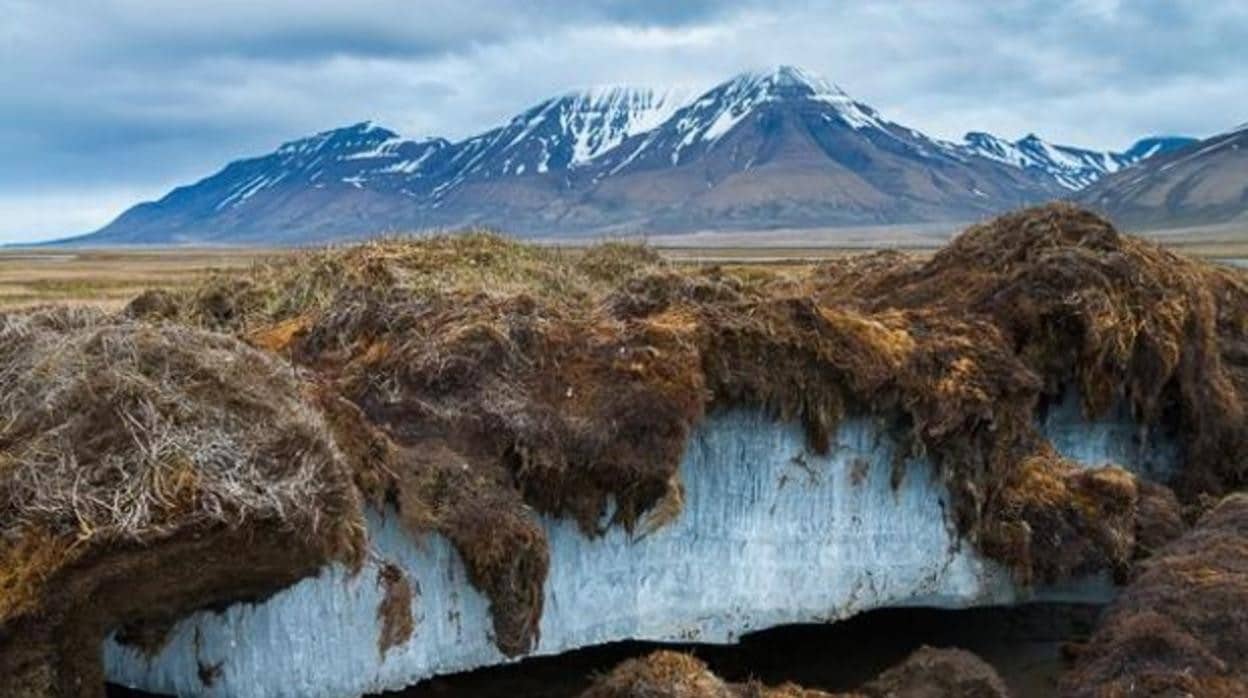
A team of geologists and biologists has managed to resurrect ancient microbes trapped in the permafrost, a frozen mixture of soil, ice, and rocks that covers nearly a quarter of the Northern Hemisphere.
Some of these microorganisms had been inactive for tens of thousands of years, but upon being thawed, they began to form living colonies capable of decomposing organic matter and releasing carbon dioxide and methane, two potent greenhouse gases.
The permafrost: a biological and climatic archive
The permafrost functions as a frozen cemetery, where mammoth bones, bison, and ancient microbes are preserved.
In the study, published in Journal of Geophysical Research: Biogeosciences, researchers collected samples of different ages in the U.S. Army Permafrost Tunnel, located beneath the soil of Alaska. There, they observed how the microbes slowly awakened, even forming visible biofilms after several months of incubation.
“These are not dead samples, far from it,” stated Tristan Caro, the lead author of the study. “They are capable of decomposing organic matter and releasing carbon.”
Climate change and microbial feedback
Prolonged thawing activates microbes that accelerate global warming.
The permafrost is thawing at an alarming rate due to global warming. As this occurs, microbes begin to decompose the stored organic matter, releasing gases that exacerbate climate change.
According to Sebastian Kopf, co-author of the study, this process could create a vicious circle: more heat, more thawing, more emissions.
“The concern is not a hot day, but the prolongation of Arctic summers, which allows warm temperatures to reach into the fall and spring,” explained Caro.
Laboratory simulations: a window to the future
The microbes take months to activate, but then form robust colonies.
To simulate future Arctic conditions, researchers incubated the samples at 3 and 12°C, elevated temperatures for the permafrost.
They used water with deuterium, a type of heavy hydrogen, to track how the microbes incorporated it into their cell membranes. Although initial growth was slow, after six months some colonies showed intense activity, not necessarily accelerating with more heat.
Risks and open questions
How do these microbes behave in other cold regions of the planet?
Although the studied microbes do not appear dangerous to humans, their ability to release carbon poses global ecological risks.
The team warns that much remains to be investigated, especially in regions like Siberia, Canada, and Greenland, where the permafrost is also retreating.
“We have only sampled a small portion,” concluded Caro. “There is a lot of permafrost in the world, and we still do not know how it will respond.”


