



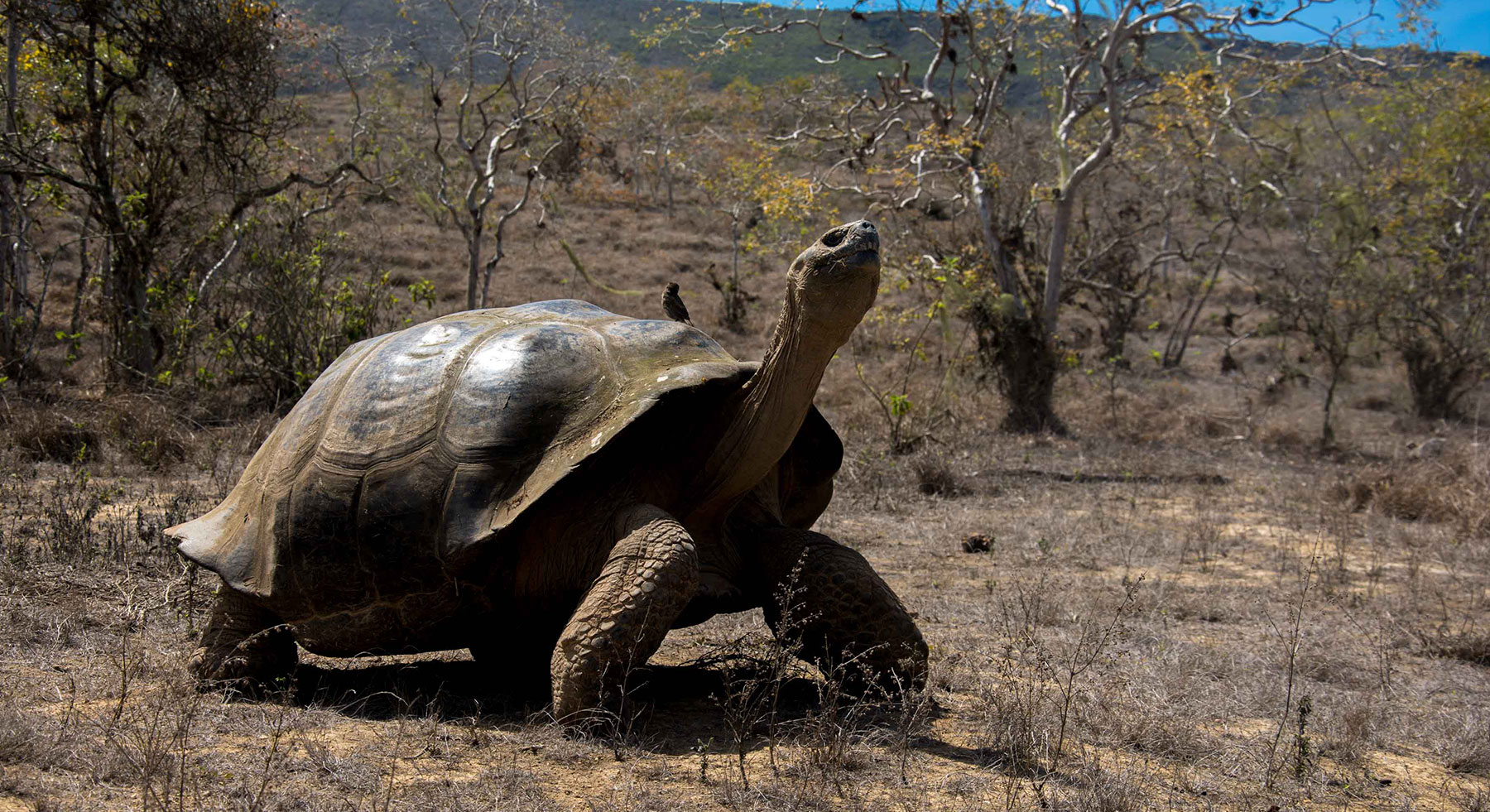
The Galápagos giant tortoises, forever associated with Charles Darwin and the theory of evolution, are one of the most recognizable icons of global biodiversity.
However, by the end of the 20th century, they were on the brink of collapse, not due to climate change or direct hunting, but because of a threat introduced centuries ago: goats, pigs, and donkeys that multiplied uncontrollably on several islands of the archipelago.
The impact of invasive species
The goats ravaged vegetation down to the roots, eliminated trees, depleted water reserves, and reduced shaded areas. For the giant tortoises, dependent on these resources to survive the dry seasons, the impact was devastating.
Traditional control measures failed, and scientists concluded that if the cause of the damage was not eliminated, the tortoises would disappear.
The Isabela Project: an uncomfortable decision
Thus, the Isabela Project was born, driven by the Charles Darwin Foundation and the Galápagos National Park Directorate, with a radical objective: completely eradicate the invasive mammals.
- Aerial hunting from helicopters was used, with specialized teams eliminating entire groups of goats in inaccessible areas.
- In a few months, some islands reduced up to 90% of their invasive population.
- To locate the last specimens, the strategy of “Judas goats” was employed: sterilized females with GPS collars that sought out other individuals, allowing scientists to track and eliminate the remaining groups.
Between 1997 and 2006, more than 150,000 goats were eradicated, along with feral pigs and donkeys. The affected islands were declared free of large introduced mammals.
The recovery of the ecosystem
The effects were immediate:
- The vegetation returned and the forests began to regenerate.
- Endemic species reappeared.
- The feeding areas of the tortoises were restored.
- The tortoise populations grew steadily.
The Isabela Project became a world reference in ecological restoration, although also an uncomfortable reminder: conserving nature sometimes involves direct and extreme interventions.
Current status of the giant tortoises
Today, the Galápagos giant tortoises remain in a vulnerable or critically endangered state, with a wild population reduced to about 15,000 individuals, compared to the 250,000 original.
- Main threats: invasive species, climate change, habitat loss, and illegal trafficking.
- Conservation efforts: breeding centers like Arnaldo Tupisa, which raise tortoises until they can survive on their own and then release them. In 2025, 170 specimens were repatriated in Isabela.
- Research: the Galápagos Tortoise Movement Ecology Program (GTMEP) monitors their routes to predict environmental impacts.
- Achievements: on islands like Española, repatriated tortoises reached sexual maturity and managed to reproduce naturally.
The case of the Galápagos tortoises demonstrates that conservation may require difficult decisions and extreme methods. It was not natural selection that saved them, but a conscious and technological scientific action, which allowed ecosystems to recover and gave a second chance to an iconic species.


