



For years, part of the scientific community considered that the iron from Antarctic melt could have a compensatory effect on global warming. However, new research questions this hypothesis and warns that the supposed benefit might be overestimated.
As greenhouse gas emissions continue to raise the planet’s temperature, the glaciers of the white continent are retreating at an unprecedented rate. Although the region is isolated from major urban centers, its transformation impacts the oceans and millions of people.
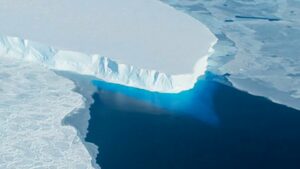
In this context, the case of the Thwaites Glacier, known as the Doomsday Glacier, is emblematic. It currently accounts for about 4% of the annual sea level rise and, if it were to collapse, it could raise it by up to 65 centimeters, increasing the risk of coastal flooding worldwide.

Iron fertilization: promises and risks in the Southern Ocean
In light of this scenario, the theory of iron fertilization emerged as a possible natural mitigation mechanism. The idea was that the iron released by the melting ice would stimulate the growth of microscopic algae capable of absorbing carbon dioxide through photosynthesis.
Subsequently, upon dying, these algae would sink into the deep ocean, sequestering carbon for long periods. Thus, iron would act as a key nutrient in the Southern Ocean, enhancing a biological process with the capacity to moderate atmospheric emissions.
However, the debate was never closed. Some specialists warned that an excessive proliferation of algae could create dead zones, that is, areas with low oxygen levels where marine life is severely affected, as has occurred in the Baltic Sea due to nutrient pollution.
New evidence from the Amundsen Sea
Recent studies conducted by researchers from Rutgers University-New Brunswick analyzed the actual contribution of iron from the melt. In 2022, the team worked on the Dotson ice shelf, located in the Amundsen Sea, one of the areas that most contributes to the rise in sea level.
There they measured the concentration of iron in the water entering under the shelf and in the water emerging after mixing with the melt. The results indicated that only about 10% of the dissolved iron came directly from the glacial water.
In contrast, most of it originated from deep ocean waters and eroded sediments under the ice. Additionally, a liquid layer without oxygen under the glacier was detected, capable of releasing iron through geological processes rather than simple surface melting.
The true utility of the released iron
Iron remains an essential micronutrient for phytoplankton and plays a key role in marine productivity. Under suitable conditions, it can stimulate food chains and favor the natural capture of carbon.
However, the new findings indicate that the melt is not the main source of this element. Therefore, relying on glacial retreat as a climate ally proves to be scientifically weak and environmentally risky.
Consequently, the accelerated ice loss in Antarctica appears less and less as a phenomenon with compensatory effects and more as a direct threat to the oceanic and coastal stability of the planet.



