



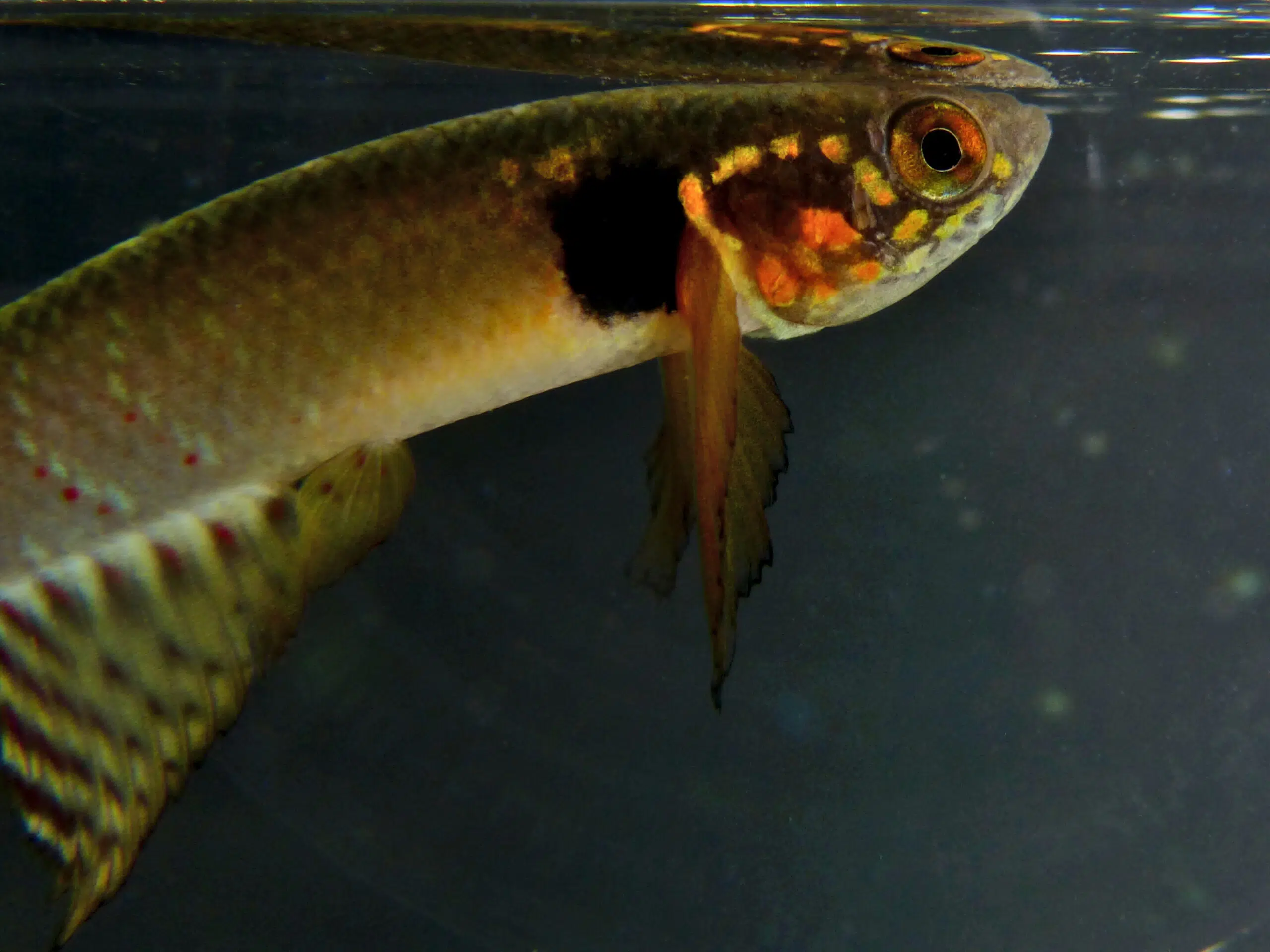
A small Bolivian fish that was thought to be extinct has reappeared after two decades without records in the wild. It is the Moema claudiae, a seasonal killifish endemic to Bolivia, whose presence was confirmed by researchers in April 2024.
The discovery, published in Nature Conservation, represents a key advancement for the conservation of species and wetlands in a country experiencing a rapid loss of biodiversity.
The discovery in Beni
Scientists Heinz Arno Drawert and Thomas Otto Litz found a surviving population of Moema claudiae in a small temporary pond. A place surrounded by agricultural lands in the Mocoví River basin, Marbán province, Beni department, about 100 kilometers from the original type locality.
This was the first record of the species since its habitat was transformed into farmland, which led the IUCN to classify it as “critically endangered” and “possibly extinct”.
The researchers used traditional methods —hand nets and observation in temporary aquariums— to capture specimens and document for the first time their behavior and biology in the wild. The collected fish were deposited in the Ichthyological Collection of the Noel Kempff Mercado Natural History Museum in Santa Cruz de la Sierra.
A unique ecosystem
The environment where Moema claudiae appeared is a blackwater, temporary, and shallow pond, with a leaf litter substrate over clay and sparse emergent vegetation. Located at the confluence between the Amazon rainforest and the Moxos Plains savannas, this site hosts a surprising diversity of seasonal killifish.
Scientists identified six other species of rivulids in the same biotope. This makes the place the one with the highest known genetic diversity of seasonal killifish worldwide. Never before had the coexistence of seven species in a single site been reported; scientific literature only documented up to five sharing habitat on other continents.
Conservation status and threats
Bolivia has 32 documented species of rivulids, of which 19 are endemic and nine are found only in their original type locality. Of the 20 species assessed by the IUCN, eight are threatened to some degree, with Moema claudiae being the only one critically endangered until this discovery.
The main threats include:
- Deforestation: Bolivia lost about 10 million hectares of forest in 25 years. In 2024 alone, the loss exceeded 1.8 million hectares, mainly of primary forests.
- Agricultural expansion: promoted by public policies in eastern Bolivia, continues to be the main cause of environmental degradation.
- Hydrological alterations and contamination with agrochemicals, which explain the disappearance of many killifish populations.
Researchers’ voices
“For me, it is something special to have rediscovered Moema claudiae. This shows that we now have the opportunity to preserve this species in its natural habitat,” expressed Thomas Otto Litz, who recalled that the fish was named in honor of Claudia, wife of Professor Wilson Costa.
Meanwhile, Heinz Arno Drawert warned: “Without quick and effective action to stop the irrational expansion of the agricultural frontier in Bolivia’s lowlands, we risk losing some of the world’s most important ecosystems and, with them, the irreplaceable goods and services they provide.”
The rediscovery of this fish brings hope for a species considered extinct. It also highlights the hidden richness of Bolivian seasonal wetlands. Protecting these ecosystems is essential for the survival of unique species and for maintaining the environmental services that support regional well-being and development.



