



The XMM-Newton telescopes, from the European Space Agency (ESA), and XRISM, from the Japan Aerospace Exploration Agency (JAXA), detected a bright explosion from a supermassive black hole. This is detailed in a study published in the journal Astronomy & Astrophysics.
This colossal object, with a mass equivalent to 30 million suns, is located in the spiral galaxy NGC 3783, situated about 130 million light-years from Earth.
A never-before-seen phenomenon
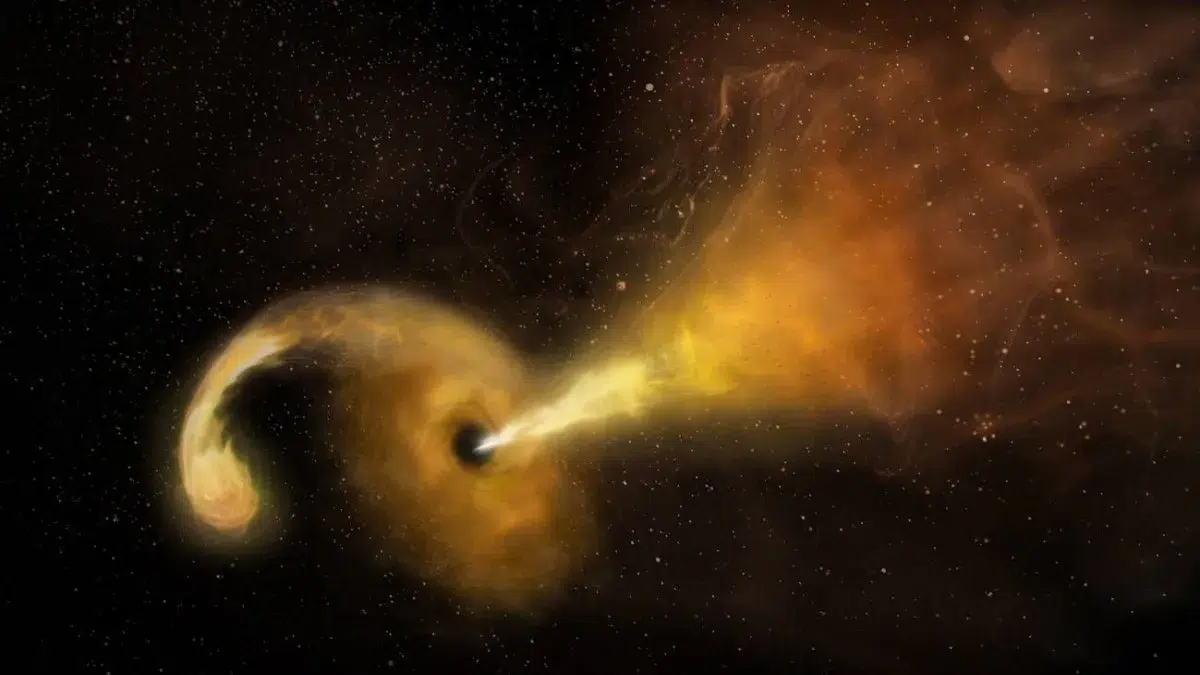
In a matter of hours, the black hole generated an unprecedented astronomical phenomenon: powerful winds that expelled material into space at speeds of 60,000 km/s.
“We have never before observed a black hole generating winds so rapidly,” stated the principal investigator Liyi Gu in an ESA press release. “For the first time, we have seen how a rapid burst of X-rays from a black hole immediately triggers ultrafast winds, which form in just one day,” he added.
Active Galactic Nucleus: the engine of the phenomenon
The identified object is powered by an extremely bright region known as the Active Galactic Nucleus (AGN), located in the heart of NGC 3783. AGNs are regions that shine with intense emissions of light and energy, and are capable of generating powerful jets and winds into the cosmos.
“AGNs are truly fascinating and intense regions, and key targets for both XMM-Newton and XRISM,” noted co-author Matteo Guainazzi.
Winds comparable to solar eruptions
The black hole winds resemble the coronal mass ejections from the Sun, when our star expels streams of overheated material into space.
This observation demonstrates that supermassive black holes could sometimes act like the Sun, making them seem “less strange” than previously thought.
“The winds surrounding this black hole appear to have been created when the tangled magnetic field of the AGN suddenly untangled, similar to solar eruptions, but on an almost unimaginable scale,” explained Guainazzi.
Implications for the evolution of galaxies
Co-author Camille Diez emphasized that windy AGNs play a key role in the evolution of their host galaxies and in the formation of new stars.
“Due to their great influence, learning more about the magnetism of AGNs and how they generate winds like these is key to understanding the history of galaxies throughout the universe,” she stated.
The telescopes behind the discovery
- XMM-Newton: has been exploring the “hot and extreme” universe for over 25 years, pioneering the study of high-energy phenomena.
- XRISM: launched in 2023, works to answer key questions about how matter and energy move through the cosmos.
The discovery of ultrafast winds in the black hole of NGC 3783 marks a milestone in modern astronomy. The detection of this phenomenon opens new doors to understanding how AGN magnetic fields influence galaxy dynamics and star formation.
This discovery reinforces the importance of space telescopes like XMM-Newton and XRISM, which continue to reveal the most extreme secrets of the universe and bring us closer to understanding how matter behaves under extreme conditions.


