



Nature and space have a surprise in store for astronomy lovers: the last solar eclipse of 2025, which will take place this Sunday, September 21. However, the fortunate ones will be those who live under the sky of New Zealand, Antarctica, and the South Pacific.
This time, it is a deep partial eclipse, where the moon will cover up to 86% of the Sun. The curious thing is that this event takes place just before the September equinox, when the Sun crosses the celestial equator, marking the beginning of spring in the southern hemisphere.
This astronomical phenomenon occurs when the Moon obscures the Sun as seen from Earth. For this to happen, the Sun, the Moon, and the Earth are aligned in such a way that it coincides with the new moon and indicates that the Moon is near the plane of the ecliptic.
In addition to partial eclipses, there are also total eclipses, where the sunlight is completely hidden by the Moon; annular and partial eclipses, if only a part of the Sun is covered.
How are partial eclipses produced?
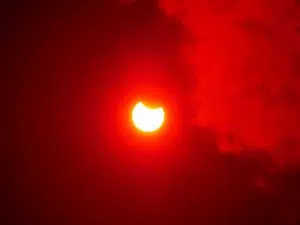
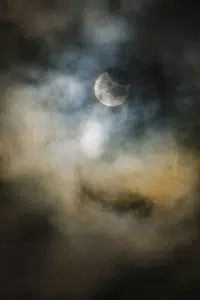
Partial eclipses occur when the Moon covers only a part of the solar disk in a Solar eclipse, or when Earth’s shadow partially darkens the Moon in a lunar eclipse. In both cases, the phenomenon is not observed in its entirety, but partially from the Earth’s surface.
In a partial solar eclipse, the Moon comes between the Sun and the Earth, casting its shadow incompletely. This causes only a fraction of the Sun to be hidden, creating a visual “bite” effect on its luminous surface.
During a partial lunar eclipse, Earth partially blocks the sunlight reaching the Moon. This generates a progressive shading that darkens a part of its surface, offering a visible spectacle to the naked eye without the need for special eye protection.
What is their frequency?
Partial eclipses are not rare phenomena, but their frequency depends on the type. On average, between two and five solar eclipses occur each year, most of which are partial and can only be seen from certain regions of the planet.
In the case of partial lunar eclipses, they usually occur once or twice a year. Their visibility is much greater than that of solar eclipses, as they can be observed from any location on Earth where the Moon is above the horizon during the event.
Although they occur relatively frequently, they are not always perceptible to everyone. Their observation depends on both geographical location and weather conditions, making each partial eclipse a unique event.



