



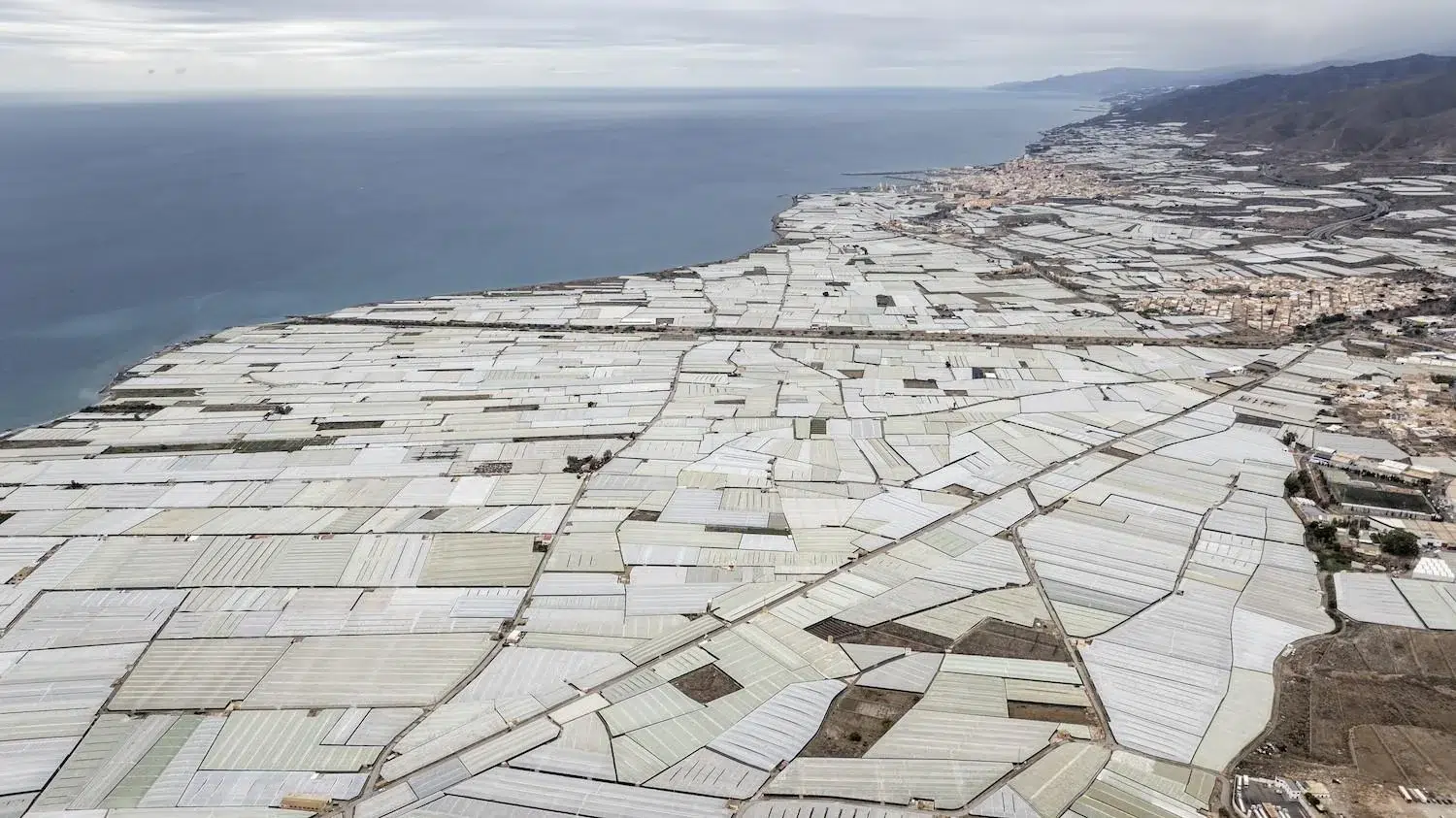
The satellite images from NASA show how, since the 1960s, the Campo de Dalías in Almería has become an immense “sea of plastic.”
What began as a technique to protect grapevines from the wind and increase production led to an intensive agricultural model that today covers thousands of hectares with greenhouses.
The reflection of sunlight on the plastic covers is so intense that the region is clearly distinguishable from space, creating a unique landscape that combines agricultural productivity and environmental challenges.
From grapes to tomatoes: unstoppable expansion
The accumulation of plastics began in the 60s when farmers discovered that the heat retained under the covers boosted the table grape harvest. After the torrential rains of 1973, which devastated much of the local crops, the protected crops survived.
Since then, the system expanded to tomatoes, peppers, melons, flowers, and other productions, consolidating Almería as a world reference in intensive agriculture.
An unexpected microclimate
Recent research reveals that the reflection of the plastic has modified solar radiation in the area, generating a cooling microclimate. While the average temperature in Spain increased by about 2 °C, slight decreases are recorded in Almería, a phenomenon directly linked to the “sea of plastic.”
This effect has turned the region into a natural laboratory to study the interaction between intensive agriculture and climate change.
The dark side: plastics and pathogens
Two studies led by the Autonomous University of Madrid warn that abandoned agricultural plastics are not simple inert waste:
- They function as reservoirs of antibiotic-resistant bacteria.
- They form biofilms from irrigation water and fertilizers with traces of antibiotics.
- They promote the spread of superbugs that can be dispersed by wind, water, and fauna.
On the nearby coast, 1,397 plastic fragments matching local agricultural materials were collected, all with the presence of pathogenic microorganisms.
Global risk to public health
The WHO considers antibiotic resistance one of the greatest health threats of the 21st century. Until now, the focus was on hospitals and intensive livestock, but the agricultural plastics of Almería open a new front:
- Mobile reservoirs of resistant bacteria.
- Dispersion into protected ecosystems and food chains.
- Potential impact on food production and human health.
This finding forces a rethink of plastic waste management in intensive agriculture and the design of policies to reduce their dispersion in the environment.
The “sea of plastic” in Almería is an example of how agricultural innovation can transform a territory and generate productive benefits, but it also poses environmental and health challenges of global reach.
What began as a solution to protect crops has become a phenomenon visible from space, capable of modifying the local climate and, at the same time, incubating invisible risks to public health.



