



Lisbon has been facing a silent but persistent challenge for years: the accumulation of waste derived from consumption in recreational areas. Since June 2025, the city became the first European capital to implement a comprehensive system of reusable cups, supported by a local model of digital deposit and return.
The first return points managed by the company TOMRA —specialized in automated recycling solutions— are already operating in two historic kiosks: Praça de São Paulo and Praça do Príncipe Real. By October 2025, a complete expansion of the system is expected with 17 collection points in the Baixa area.
How reusable cups work
- Consumers receive their drink in a reusable cup, leaving a deposit of 0.60€ at the time of purchase
- The refund is automatically made when returning the cup at TOMRA points, without the need for registration, simply by touching with a card or mobile phone
- TOMRA takes care of collection, cleaning, and redistribution, efficiently closing the cycle
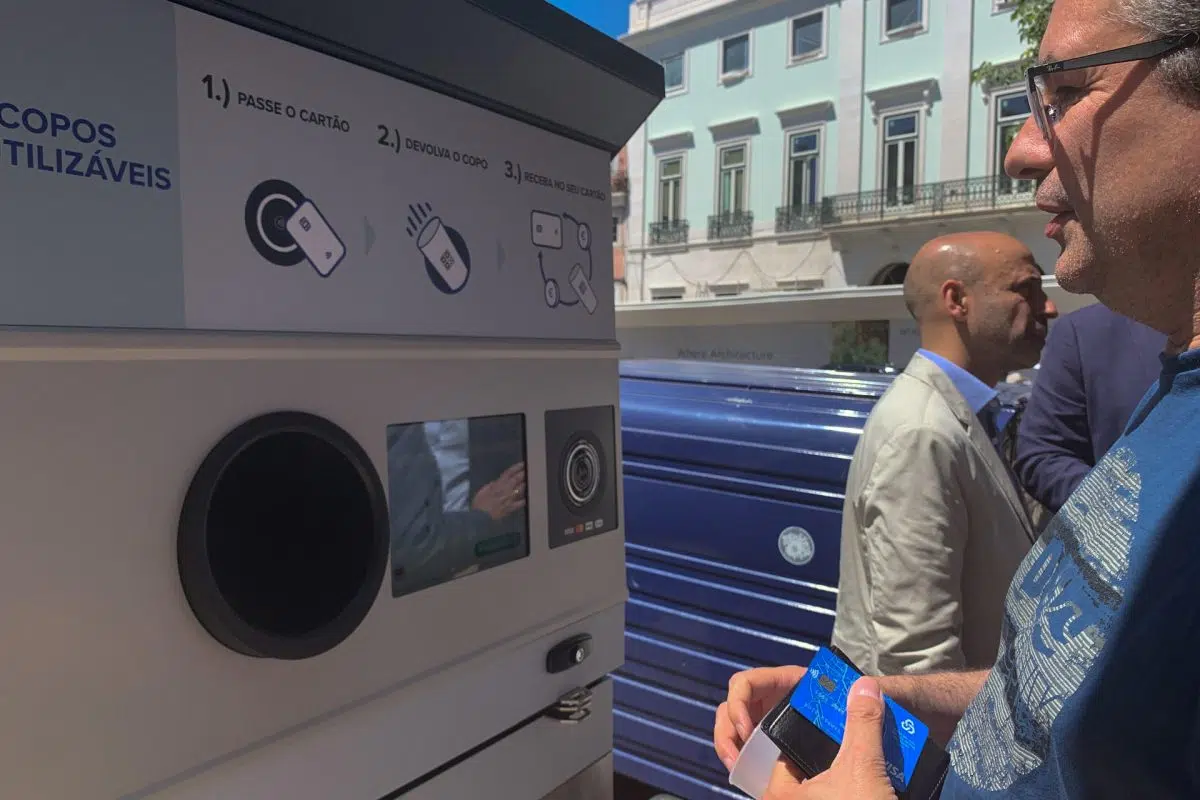
Alliance between city, technology, and gastronomic sector
The initiative arises from a collaboration between the Lisbon City Council, TOMRA, and the AHRESP association (which brings together hotels, restaurants, and bars). This deployment responds to the municipal ordinance of 2024. It prohibits the use of disposable cups and demands functional infrastructure to ensure a habit change.
“The goal is to promote a true culture of reuse in the city and inspire other municipalities,” said Rui Cordeiro, Councilor for Waste and Circular Economy. “It is a concrete step towards more conscious consumption.”
From AHRESP, its president Carlos Moura highlighted that this model offers a practical and replicable solution: “The HORECA sector goes from being part of the problem to leading the change, alongside its customers.”
Metropolitan-scale reuse
The model not only aims to reduce waste but also minimize emissions, integrate technology seamlessly for the consumer, and promote a cleaner and more functional urban environment.
The introduction of a standardized “Lisbon Cup” scheduled for October will consolidate the system in cafés, bars, and nightclubs in the historic center, with a consistent visual language and adapted design.
The system was presented at the summit Lisbon towards reuse, held at the Museum of Design and Fashion (MUDE). There, urban planners, policymakers, and environmental activists tested the mechanism and explored its scalability potential.



