



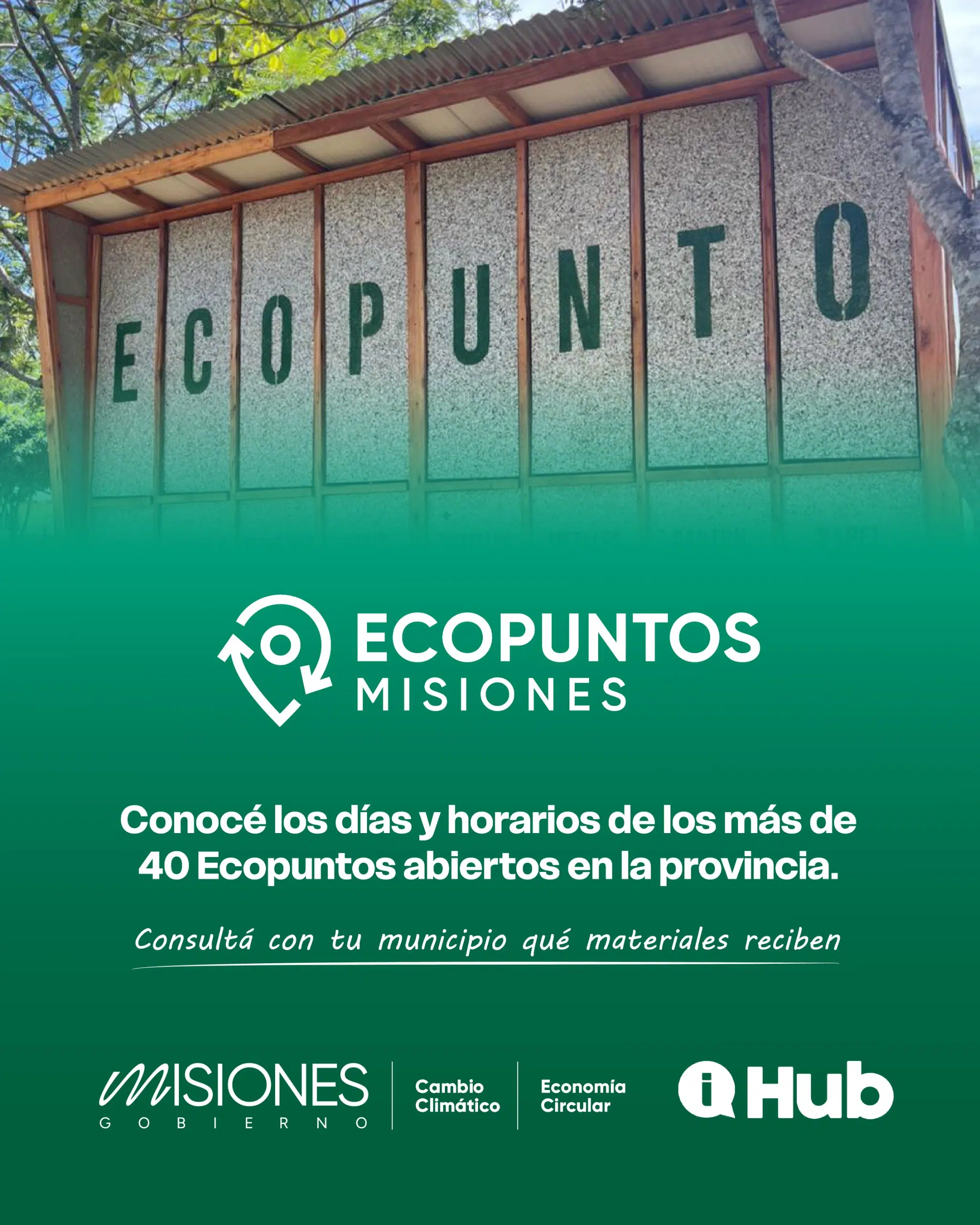
The province of Misiones consolidates its environmental commitment with 40 active Ecopoints in 20 municipalities, creating a network that drives the circular economy and promotes responsible consumption habits.
The Provincial Program ECOPUNTOS MISIONES is presented as a key tool for each resident to separate and properly dispose of their recyclables, integrating the logic of the 3Rs (Reuse, Reduce, and Repair) into daily life.
“The Ecopoint adapts to the needs of each municipality and its local actors, who will be responsible for giving a new use to the collected materials,” highlighted Fernando Santacruz, undersecretary and promoter of the initiative.
Access and citizen participation
Through an interactive map, residents can locate the nearest point to their home, check reception days and hours, and actively join in caring for the environment. Information cards and digital communication reinforce community participation, turning waste separation into a collective habit.
Pillars of Misiones’ environmental policy
The provincial strategy is part of a broader policy that places the Paranaense jungle at the center of development. This ecosystem, considered a carbon sink, absorbs millions of tons annually and constitutes the last great remnant of biodiversity in the region.
The fundamental pillars include:
- Conservation and sustainability: rational use of natural resources, protection of wildlife with modern technology, and comprehensive watershed management.
- Regulatory framework: application of the Law XVI No. 35 on environmental impact and the Law XVI No. 105 on native forest management.
- Innovation and green economy: REDD+ programs, carbon credits, and policies that turn environmental protection into economic opportunities.
- Waste management: prohibition of hazardous and radioactive waste, regulations for the treatment of urban solid waste, batteries, and electronic devices.
- Education and participation: promotion of environmental awareness and comprehensive education, involving municipalities and communities in territory protection.
From linear to circular
The transition to a circular model requires state policies that create the regulatory framework, economic incentives, and necessary infrastructure. In Misiones, these actions allow:
- Reducing waste and promoting responsible consumption.
- Decreasing dependence on virgin raw materials.
- Generating green jobs linked to recycling, repair, and remanufacturing.
- Mitigating greenhouse gas emissions.
Strategic benefits
Circular policies provide:
- Clear regulations for waste management and design of durable products.
- Strengthening of the local economy, reducing dependence on imported inputs.
- Boosting responsible consumption, with eco-labeling and certifications.
- Creation of green jobs, improving industrial competitiveness.
- Climate change mitigation, with significant emission reductions by 2050.
Concrete examples include extended producer responsibility (EPR), sustainable public procurement, and support for green business ventures.
Misiones’ environmental strategy, defined more than 40 years ago, reaffirms the decision to place nature at the center of development. The Ecopoints are a key piece of this policy, which combines conservation, innovation, and citizen participation to build a more sustainable and resilient future.


