



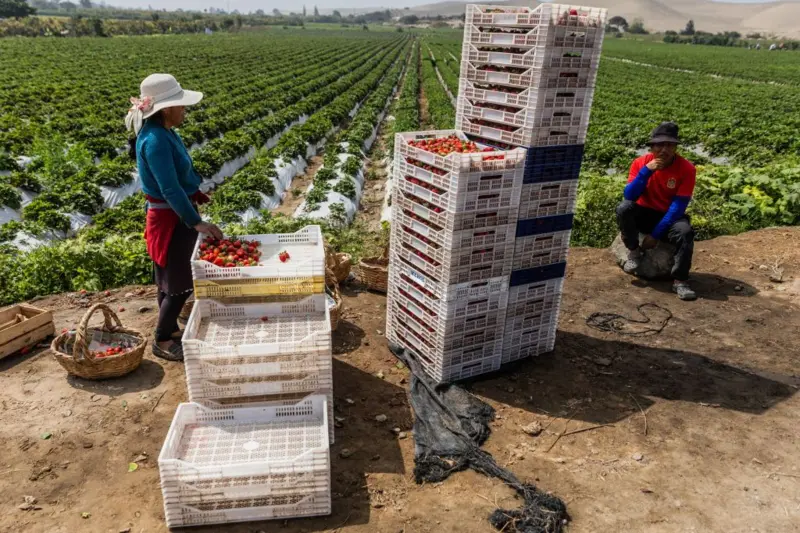
The vast desert plains of the Ica region in southwestern Peru have radically changed their landscape in a few decades. Areas that once showed little more than sand and wind now concentrate intensive crops of blueberries, grapes, asparagus, and mangoes.
This phenomenon is repeated in much of the Peruvian coastal desert, transformed into a large agricultural corridor that supplies markets in the United States, Europe, and Asia. The cultivated area has grown strongly since the 1990s, giving rise to an agro-export industry that set a record in 2024.
The Ministry of Agrarian Development and Irrigation reported that the sector grew at an average annual rate of 11% between 2010 and 2024, reaching US$9.185 billion in exports. Peru thus consolidated itself as a strategic global producer, especially during times of the year when the northern hemisphere faces climatic limitations.
The foundations of growth in the desert
The expansion began in the 1990s when the country promoted reforms aimed at attracting investment and boosting sectors with export capacity. Agribusiness became a concrete alternative after overcoming decades of limitations in the Amazonian soils and Andean slopes.
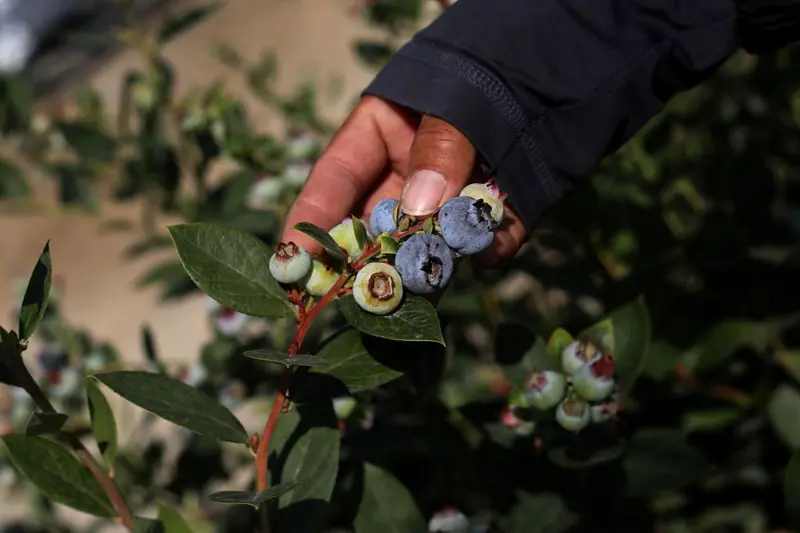
The arrival of private capital allowed the incorporation of drip irrigation technologies, hydraulic engineering, and genetic improvements applied to crops like blueberries, previously absent in the region. The availability of water became the key piece to enable large-scale agriculture in arid areas.
With these investments, the cultivable area of the coast increased by about 30%. Regions like Ica and Piura were consolidated as production and export hubs, changing the economic and social dynamics of vast territories.
Impacts and tensions in the new agricultural model
The agro-export growth reconfigured the local economy. Formal employment expanded in areas where informality predominated, and many workers gained access to more stable incomes thanks to agricultural companies.
However, this progress did not benefit everyone equally. Small farmers face higher labor costs and difficulties competing for basic resources, especially water. In several areas, land changed hands under the economic pressure of the new model.
The productive reconversion also altered traditional farming systems and modified the social structure, favoring large companies that concentrate most of the activity.
Water, the axis of environmental conflict
The main environmental concern is the consumption of water in regions where availability is limited and the population lacks regular supply. In areas like Ica, where rainfall is minimal, much of the resource comes from underground.
While human settlements must resort to supply via tanker trucks, agro-export farms have deep wells and priority access to irrigation from other regions. The decline in groundwater levels, reported for more than a decade, has raised concerns among local producers.
The increasing drilling of deep wells, coupled with the intensive use of the resource, deepens the gap between the population and the agricultural sector, in a scenario where sustainability in the long term is under debate.
A future at risk if the water resource is not protected
Water management has become the main challenge of the agro-export model. Scarcity is advancing, and pressure on aquifers puts the sector’s economic continuity at risk.
Experts warn that without policies ensuring the supply to the population and the conservation of ecosystems, the industry could face insurmountable natural limits. The discussion has become recurrent in electoral times, but still without structural solutions.
The balance between intensive production and water sustainability will be decisive for the agricultural and social future of the country.
Environmental and social benefits of promoting a sustainable agribusiness
The current debate has led to new initiatives aimed at improving the sector’s sustainability, with potential positive effects for the environment and communities.
Promoting efficient irrigation technologies reduces the pressure on aquifers and decreases water loss in arid areas. The responsible use of the resource also favors the natural recharge of soils and prevents the deterioration of wetlands and coastal ecosystems.
The transition to responsible production models can strengthen local economies, expand access to formal employment, and improve water security for the population. In the long term, a sustainable agribusiness boosts climate resilience and protects the country’s strategic resources.



