



The province of Santa Fe is facing a structural crisis in the management of urban waste. Although the current regulations mandated the elimination of open-air dumps by 2012, more than 300 remain active.
The recent fire in Sauce Viejo reignited a problem that combines management failures, territorial inequality, and severe environmental risks. Authorities acknowledge progress in forming regional consortia for sustainable management.
These spaces allow municipalities to join forces to maintain sanitary landfills, reduce costs, and ensure controls. However, there are still regions without operational consortia or available land for final disposal.
The percentage of the population with access to a sanitary landfill increased from 62% to 70% in recent years. Official projections estimate reaching 80% by 2027 with the incorporation of new localities. Even so, a third of the territory still depends on obsolete, polluting, and dangerous practices.

Why dumps persist: limits, costs, and cultural challenges
Waste management depends on local governments, creating marked inequalities. Many municipalities lack resources or technical capacity to sustain a comprehensive system. Additionally, a culture of informal disposal persists, favoring the proliferation of dumps.
The operation of consortia requires common strategies for separation, collection, and reduction of waste. The challenge is for localities to coordinate these processes to reduce the volume reaching landfills. Half of the waste is organic matter, which would allow for a substantial reduction in transfers.
The provincial government prioritizes support and organization over sanctions. Agreements, technical assistance, and equipment delivery are promoted for affiliated municipalities. Educational workshops and the strengthening of cooperatives working in sorting plants are also encouraged.
How open-air dumps pollute and their impacts on health and the environment
Dumps generate soil contamination from leachates that seep without protective barriers. These liquids carry heavy metals, toxic substances, and pathogens to groundwater and watercourses.
Uncontrolled waste degradation causes loss of biodiversity and irreversible damage to local ecosystems. Burning waste releases dioxins, furans, and highly toxic fine particles.
These emissions increase respiratory diseases, eye irritations, and cardiovascular problems. In extensive fires, the risk multiplies for nearby communities and informal workers.
The accumulation of waste attracts vectors like flies, rodents, and mosquitoes. These species act as disease transmitters and directly affect public health. Socially, dumps are often located near vulnerable sectors, deepening environmental inequality.
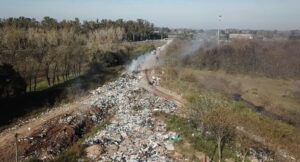
An environmental problem with direct social impact
The use of improvised transfer sites exposes municipalities to incidents such as fires or spills. The lack of adequate infrastructure increases costs and makes it difficult to comply with current legislation.
In many cases, families dependent on informal recycling work without protection in high-risk environments. To reduce the pressure on landfills, source separation and home composting are promoted.
These actions reduce up to half of the total volume of transported waste. Citizen participation becomes essential to advance towards more sustainable models. The eradication of dumps requires regional planning, environmental education, and constant financing.
Each locality must integrate into a consortium to access economic and technical support. The goal is to ensure a modern, inclusive, and environmentally responsible management throughout the province.


