



A team of researchers from the National University of the Northeast (UNNE) developed a prototype of resilient ecological bricks, made from recycled PET plastic.
They will be destined for the construction of houses in the northeast of Argentina. The development is particularly relevant because currently, only 30% of this material consumed in Argentina is recycled.
Resilient ecological bricks made from PET: how was the research conducted
Architect Lucía Villalba led the innovative research that began during her undergraduate studies with a scholarship from the General Secretariat of Science and Technology of the university. The project assessed the feasibility of transforming polyethylene terephthalate plastic waste (PET) into sustainable inputs for the manufacture of bricks intended for house construction in the northeast of Argentina.
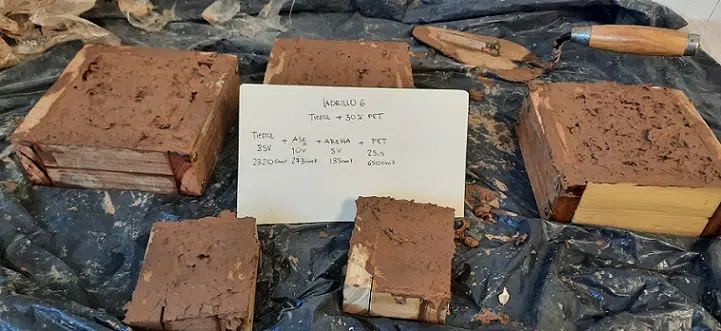 Bricks in development. (Photo: FAU-UNNE).[/caption>
Together with Dr. Herminia Alías, teacher and researcher at the Institute for Energy Efficiency Development in Architecture (IDEEA) of FAU-UNNE, and engineer Pablo Martina, researcher from the Renewable Energy Group (GIDER) of FI-UNNE, they formed a multidisciplinary team that delved into this line of research.
They conducted case studies, visited PET collection points in Resistencia, Chaco, and systematized properties and benefits of using waste in construction.
The problem of plastic waste pollution in Argentina and the region
Each inhabitant of the country produces approximately 1.15 kg of urban solid waste daily. In total, this generates a ton of garbage every two seconds.
Only 30% of the PET plastic consumed in Argentina is recycled. The rest, with a decomposition time exceeding 100 years, contaminates the environment and contributes to the plastic problem in ecosystems.
In the Metropolitan Area of Gran Resistencia (AMGR), which is home to more than 385,000 people, about 9000 tons of municipal waste are blamed monthly. However, only 1.13% of the plastic generated in the region is effectively recycled.
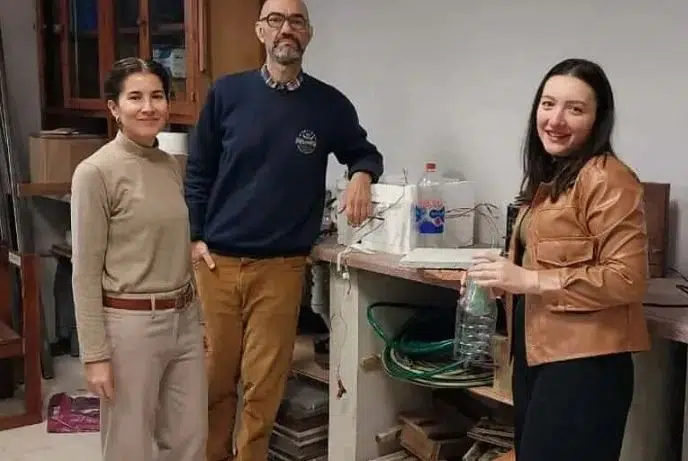 The team that developed the bricks. (Photo: FAU-UNNE).[/caption>
Faced with this reality, the researchers propose to reuse PET, a highly abundant and recyclable waste, to create sustainable and ecological construction components.
Reuse of PET in construction: an environmental and technological solution
The research concluded that the reuse and recycling of PET in the manufacture of modular bricks for houses is a viable option. It offers multiple environmental benefits by reducing waste that ends up in landfills or contaminating the environment.
Field studies included visits to collection points, such as “Inplástico,” which processes 100 tons monthly; “Sembrando Conciencia,” which collects one ton of PET monthly; and “Ecoqiru,” a company from Chaco that produces “plastic wood” and has collected over 2 tons of PET.
In the laboratory, without industrial machinery, the team manually crushed the PET bottles, cutting them into small squares of approximately 5 millimeters. With this material, they developed three brick prototypes with different percentages of PET and mixes:
- Prototype 1 (P1): 350 g of cement + 700 g of sand + 30 g of PET (3%)
- Prototype 2 (P2): similar to P1, but with 10% PET
- Prototype 3 (P3): mix of soil and PET (10%), without cement
- Results of resistance tests and thermal properties
The cement prototypes (P1 and P2) showed excellent results, achieving resistances of 8.60 MPa and 9.46 MPa, surpassing the 5 MPa of traditional ceramic bricks. This indicates that they could be used in structural elements and load-bearing enclosures.
The brick with soil instead of cement had very low resistance (1.59 MPa), ruling out its structural use.
Regarding thermal properties, the results showed that the bricks with 10% PET had a thermal conductivity of 1.032 W/mK, slightly higher than ceramic bricks (0.81 W/mK). However, previous studies indicate that bricks with 50% PET achieve much lower conductivity values (0.15 W/mK), making them excellent thermal insulators.
Challenges and next steps in the development of reusable bricks with PET
The main obstacle was the lack of industrial machinery to crush PET in higher percentages, thus limiting the amount of plastic in the prototypes. However, the researchers emphasize that there are national and international precedents with percentages of PET exceeding 30%.
Despite this limitation, they are already planning the next steps: considering the reuse of other discarded plastics, testing higher dosages, and exploring other formats of modular construction elements that can be applied in different building components.


