



In the midst of the race to reduce emissions from maritime transport, engineer Juan Francisco Sarmiento Medina, native of Gran Canaria, has developed a disruptive proposal: E-MAST, a mast capable of generating clean energy harnessing the wind, sea waves, and hull vibrations.
This system, already patented in Spain, is seeking funding to transition from theoretical plans to open-sea testing, with applications ranging from recreational navigation to scientific research, defense, and ocean drones.
How E-MAST Works
Inspired by the bladeless wind turbines Vortex Bladeless, E-MAST uses a magnet and a coil to convert structural vibration into electric current. Additionally, it incorporates an encapsulated internal rotor that channels air to:
- Generate additional force
- Release microbubbles under the hull, reducing friction with the water
- Oxygenate the marine environment, improving the quality of the aquatic habitat
One of its most notable advantages is that it works with any type of movement: wind, waves, or currents, even when the ship is moored or anchored.
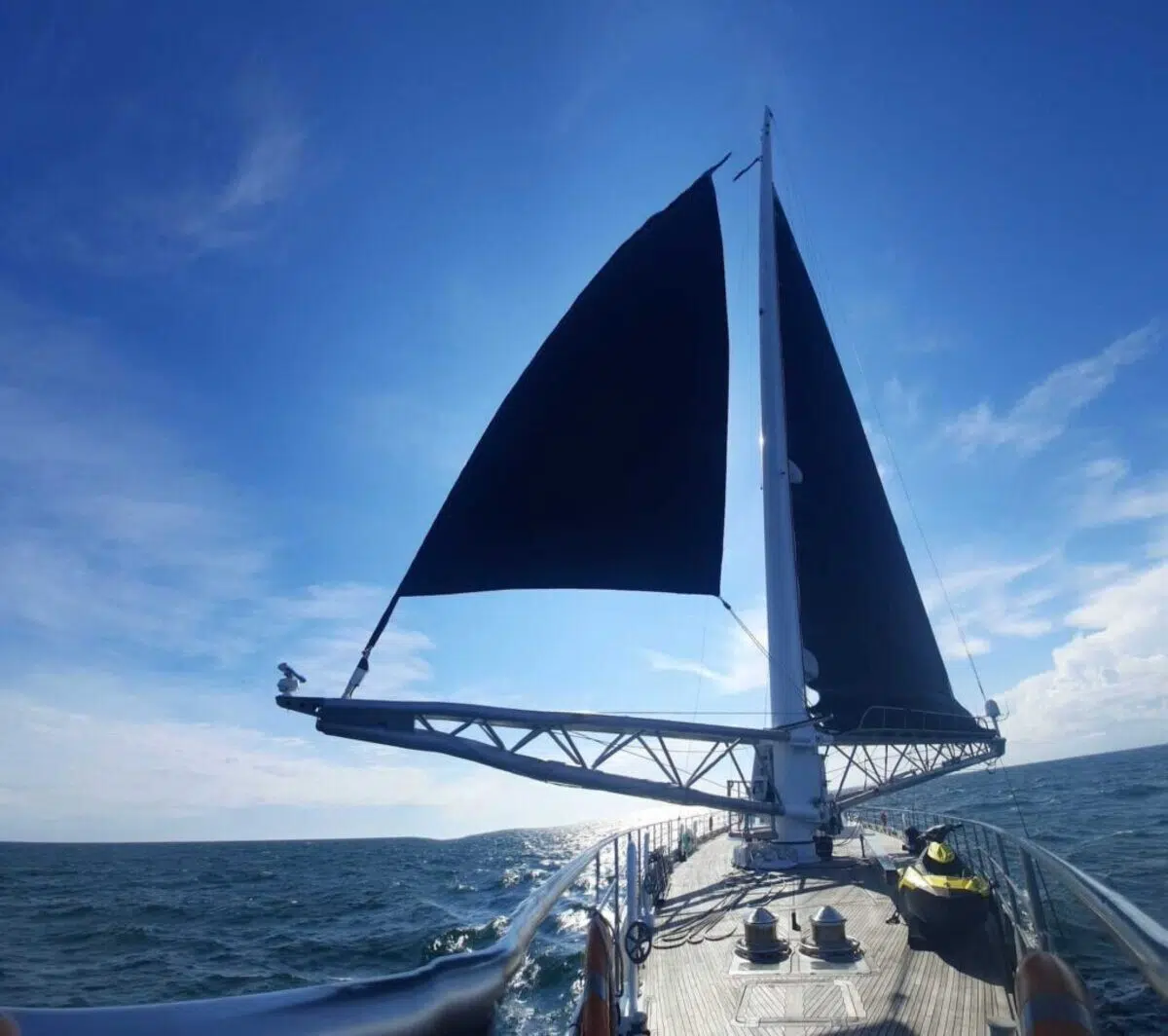 E-Mast transforms the sea into energy
Energy in Three Axes
In theoretical simulations, E-MAST can generate energy from:
- Lateral movement of the mast
- Induced rotation inside
- Tidal pumping of the keel
This makes it a constant source of renewable energy, capable of powering onboard systems (such as navigation, lighting, or hot water) or charging batteries without relying on fossil fuels.
From Sailboats to Ocean Drones
Although the invention originated on a 50-meter sailboat named Dwinger, its creator has divided the patent into independent modules that could be adapted to:
- Scientific research vessels
- Merchant ships
- Long-range ocean drones
In the latter case, E-MAST has garnered interest from institutions linked to national security, due to its ability to provide silent propulsion, without visible propellers or wakes.
Integrated Design and Naval Aesthetics
Without external elements affecting aerodynamics or safety
Unlike other systems like rotor sails (based on the Magnus effect) or microbubble systems on cargo ships, E-MAST integrates all its components within the mast, which:
- Preserves the aesthetics of the ship
- Enhances structural safety
- Optimizes aerodynamics
The project is seeking an investment of around 500,000 euros to protect the patent internationally. Sarmiento is already in discussions with shipyards in France and the Netherlands to begin mass production.
A Solution for the Decarbonization of Maritime Transport
In a context where the International Maritime Organization (IMO) demands that the shipping sector reduce its carbon footprint, E-MAST emerges as a key piece for sustainable nautical. Currently, maritime transport accounts for about 3% of global CO₂ emissions.
“Electric cars still depend on plugs, but this system allows a ship to generate its own energy self-sufficiently thanks to the sea,” Sarmiento stated in an interview with the portal El Español.



