



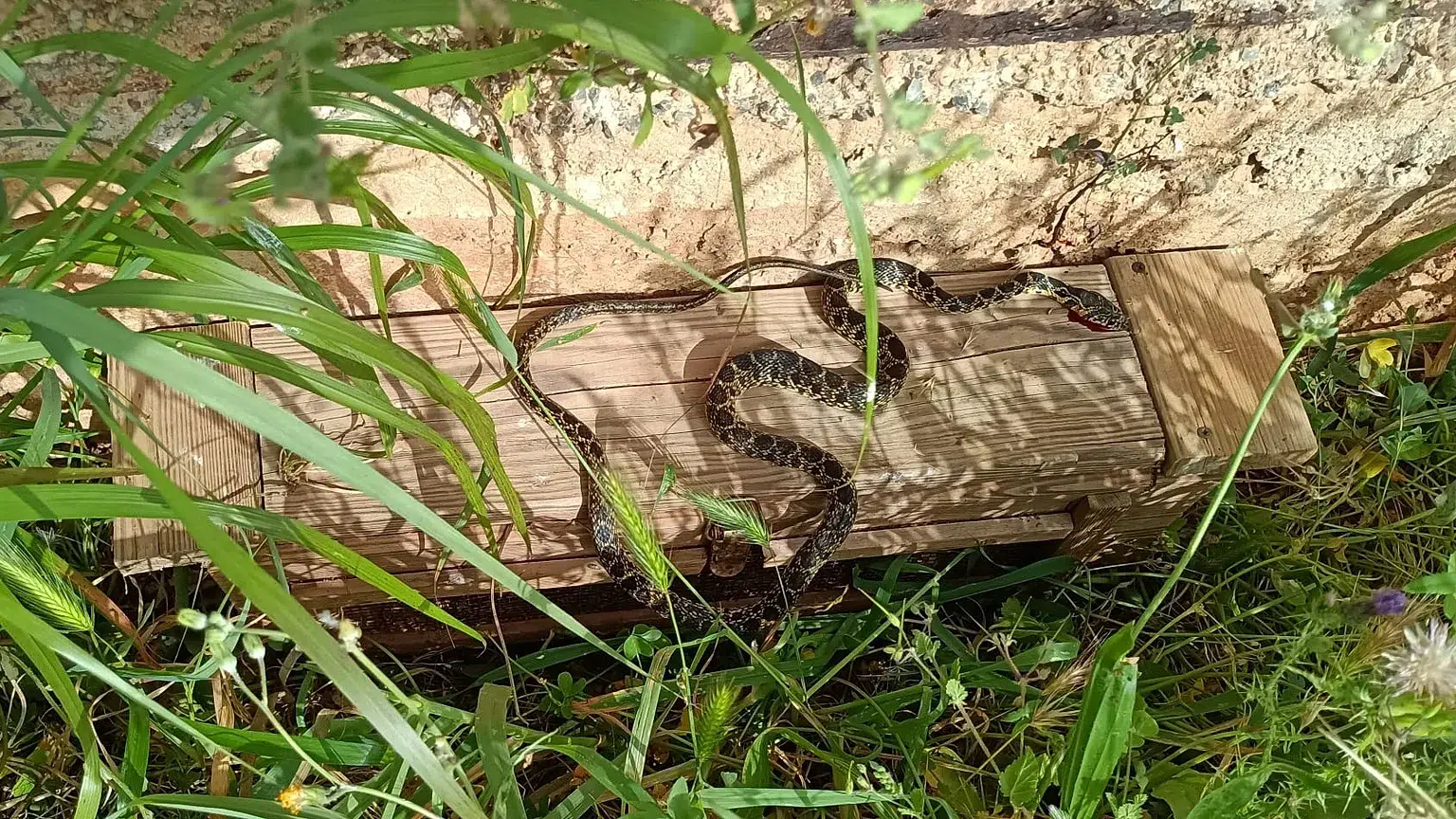
The expansion of the horseshoe whip snake (Hemorrhois hippocrepis) in the Balearic Islands has become one of the greatest threats to local wildlife.
Accidentally introduced from the Iberian Peninsula along with ornamental olive trees, this invasive species has colonized much of Ibiza and Formentera, causing the decline of native lizards, especially the Pityusic lizard (Podarcis pityusensis)**, exclusive to the archipelago and now endangered.
Origin of the invasion
The arrival of the horseshoe whip snake is linked to the trade of large ornamental olive trees from the Peninsula. The first sighting was recorded in Ibiza in 2003, and by 2006 it had reached Mallorca, arriving in Formentera in 2010.
Official studies indicate that the reptiles traveled hidden in the roots of trees transported for gardening.
There were even documented cases linked to ornamentation companies in Ibiza, confirming that the introduction was not accidental.
A super predator without competition
In the Balearics, the horseshoe whip snake acts as a super predator:
- It feeds on small mammals, other snakes, and especially local lizards.
- It has no natural competitors in the island’s food chain.
- It has colonized 90% of Ibiza, and local extinctions of lizards have been recorded on several islets.
In 2024, a snake was documented swimming in the Balearic Sea for the first time to reach new islets, demonstrating its capacity for expansion.
Ecological impact
The disappearance of the Pityusic lizards implies serious consequences:
- Insect control: they regulate arthropod populations.
- Seed dispersal: they contribute to plant regeneration.
- Pollination: they participate in the ecological balance of the islands.
Their loss disrupts the ecosystem and favors imbalances that affect both biodiversity and local agriculture.
Insufficient measures
The Balearic Government approved restrictions on the importation of trees during snake egg hatching periods, but these measures came too late.
Since 2016, about 12,000 snakes have been captured, although experts consider the efforts insufficient given the magnitude of the invasion.
Other invasive species
The horseshoe whip snake is not the only snake introduced in the Balearics. There are also:
- Ladder snake (Zamenis scalaris).
- Viperine snake (Natrix maura).
- Montpellier snake (Malpolon monspessulanus).
Although none of them are dangerous to humans, they all pose a risk to local wildlife. The venomous vipers from the Peninsula (asp, snub-nosed, and Cantabrian) have not yet reached the islands.
The invasion of the horseshoe whip snake in the Balearics is a paradigmatic case of how exotic species can alter fragile ecosystems. The lack of early measures allowed this reptile to establish itself as a dominant predator, endangering the survival of unique species like the Pityusic lizard.
The challenge now is to contain its expansion and protect island biodiversity before the losses become irreversible.



