



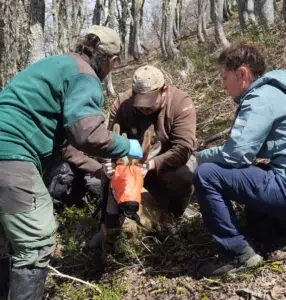
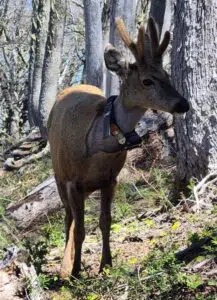
A team comprised of the National Parks Administration (APN), the Huilo Huilo Foundation from Chile, and Rewilding Argentina Foundation successfully recaptured the young huemul Newenche in the northern area of the Nahuel Huapi National Park. The goal was to replace its transmitter collar and continue satellite tracking of its journey through the Andes Mountains.
Newenche was born in the wild in November 2023 in the Huilo Huilo Biological Reserve in Chile. In January 2025, it began its natural movement towards the Lanín National Park, where its presence marked a historic event: huemuls had not been recorded in the area for three decades. From there, it continued its journey to Nahuel Huapi, where it remains under monitoring.
The specimen traveled about 80 kilometers in a straight line, crossing rugged and hard-to-access areas. Its tracking allowed for the identification of movement routes and key areas within the biological corridor, providing essential information for the conservation of the species.
The operation was carried out under strict protocol and quickly, minimizing the stress on the animal. The new collar, equipped with GPS technology, will allow for real-time data collection and response to risks such as road crossings or approaches to inhabited areas.
An alliance for Andean conservation
The capture and monitoring of Newenche symbolize a model of binational cooperation between Argentina and Chile. Since 2005, the Huilo Huilo Foundation has been developing a comprehensive huemul conservation project that combines breeding, reintroduction, and monitoring. Some specimens, born in the wild, have begun to naturally cross the border, creating new opportunities to repopulate Argentine territories.
This collaboration was strengthened in 2018 with a Technical Cooperation Agreement between the APN and the involved foundations. The agreement promotes the exchange of knowledge, training, and joint work to protect threatened species and their habitats.
The tracking of Newenche demonstrates that conservation knows no borders: coordinated efforts between public and private institutions are key to restoring ecosystems and ensuring the survival of species at risk.
The conservation status of the huemul
The huemul (Hippocamelus bisulcus) is a deer native to the Andean-Patagonian forests and one of the most threatened mammals in the Southern Cone. It is estimated that there are fewer than 1,500 individuals in the wild, distributed in small, isolated populations between southern Chile and southwestern Argentina.
Its main threat is habitat loss, caused by the expansion of livestock, fencing, and forest fires. Added to this are poaching, harassment by dogs, and competition with introduced species such as the red deer and wild boar.
The fragmentation of its population hinders genetic exchange, which exacerbates the risk of local extinction. Therefore, monitoring, connectivity, and environmental education actions are essential to reverse the trend and promote its recovery.
The laws that protect the huemul
In Argentina, the huemul was declared a National Natural Monument in 1996, the highest protection category that can be granted to a species. This legal status, established by National Law No. 22.351, prohibits its hunting, capture, or possession, and obliges the State to implement active measures for its preservation.
Internationally, the International Union for Conservation of Nature (IUCN) classifies it as “Endangered,” and it is also listed in Appendix I of CITES, which prohibits its international trade.
Patagonian provinces, such as Neuquén, Río Negro, Chubut, and Santa Cruz, complement this protection with local regulations, establishing severe penalties for those who harm or disturb this emblematic species.
Where the Andean deer lives
The huemul inhabits mountain environments among forests, shrubs, and high-altitude grasslands. It prefers areas close to watercourses and with little human presence. In Argentina, its main populations are concentrated within protected areas such as the Lanín, Nahuel Huapi, Los Alerces, and Perito Moreno National Parks.
In Chile, it is distributed in southern regions such as Los Ríos, Aysén, and Magallanes, within natural reserves and national parks. These territories form a vital biological corridor that connects both countries and allows for exchange between populations.
The story of Newenche is a testament to the potential of this ecological connectivity. Its natural journey across the mountain range not only symbolizes hope for the species but also serves as a reminder that effective conservation requires collaboration, knowledge, and respect for wildlife.



