



Two types of key corals of the Florida reefs, United States, have now been declared as functionally extinct.
These are the staghorn and elkhorn corals that for millennia built the Florida reefs.
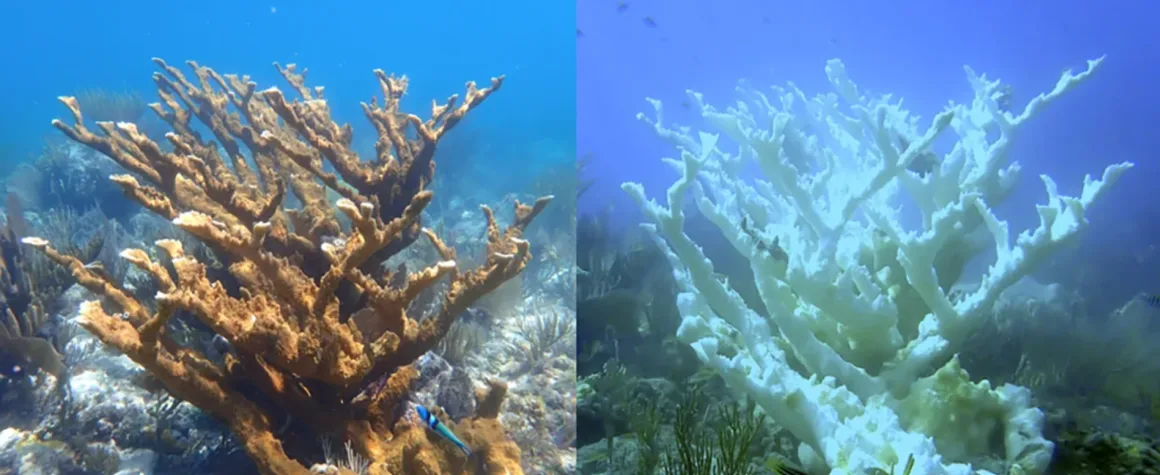
Now, a new study confirms that the record ocean temperatures of 2023 devastated these key species of the marine ecosystem.
During the summer of 2023, Florida’s waters recorded temperatures above 32°C, the highest in at least 150 years.
This marine heatwave lasted approximately three months, enough time to cause a massive and lethal bleaching of the corals.
To define this, researchers monitored more than 52,300 Acropora corals along the 563 kilometers of Florida’s reef system, from Dry Tortugas to the St. Lucie Inlet.
By March 2024, between 98% and 100% of the colonies in the southern end of the system had died, according to the study led by the NOAA’s Coral Reef Watch and the Shedd Aquarium in Chicago.

Corals in “functional extinction”: What does it mean?
Although some specimens of these corals still exist, “they are no longer present in densities high enough to fulfill their ecological function.”
This means they cannot “build and maintain the structure of the reef,” explained Ross Cunning, research biologist at the Shedd Aquarium and author of the study.
This stage often precedes the total disappearance of a species.
The few survivors, located mainly in the northern end of the system, remain vulnerable to diseases, predators, and damage from storms.
Extinct corals: their “cascading” impact
These extinct corals trigger “cascading impacts,” warned Cunning.
He listed: “Reef growth slows down, habitat complexity decreases, and fish and invertebrates lose the shelter and resources they depend on.”
Moreover, with the extinct corals, coasts become more exposed to storms and erosion.
These corals, which for the last 10,000 years were the main reef builders in the region, were already critically endangered due to:
- diseases;
- pollution;
- hurricanes;
- ocean warming.
A bleak future without immediate action
Regarding climate projections, these are not optimistic either: specialists suggest that a severe coral bleaching will occur every year by 2040.
The report warns that “true global extinctions” of multiple coral species could occur in the coming decades throughout the Caribbean region.
In this context, a recent study by the University of Exeter determined that warm-water coral reefs have already surpassed a critical point due to climate change.
Therefore, large-scale reefs will be lost unless global warming is reversed.
In this scenario, scientists have been cultivating colonies in land and marine nurseries to bolster populations.
However, the success of this strategy will depend on the frequency and severity of future bleaching episodes.
Keri O’Neil, director of the Coral Conservation Program at the Florida Aquarium, described the findings as “extremely significant” and highlighted the urgency of reducing pollution.
However, she clarified that functional extinction does not imply total disappearance: “Human intervention, combined with an improvement in ocean conditions, can reverse this trend.”
Cunning emphasized that the report represents “a call to action” rather than a message of despair.
“The window to prevent further losses is closing rapidly, but targeted interventions and aggressive climate action can still make a difference,” he concluded.


