



The massive arrival of sargassum in the Mexican Caribbean no longer only represents an environmental or touristic issue. Faced with the record increase of this algae in 2025, researchers, entrepreneurs, and local governments are turning a crisis into an opportunity, with creative and sustainable solutions.
In the beaches of Quintana Roo, more than 50 tons are collected daily, which used to end up in landfills. Currently, that material is being turned into useful inputs: from fertilizers to natural cosmetics.
The goal is clear: reduce the ecological impact of sargassum and, at the same time, capitalize on its economic potential. Several initiatives are already moving in that direction, with products that emerge directly from the marine fiber.
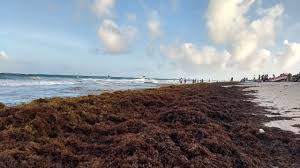
Construction, agriculture, and energy: new uses of sargassum
Universities and technological centers have developed ecological building blocks based on sargassum, designed for affordable housing. Their strength and low cost make them ideal for communities with limited resources.
In the agricultural field, the algae transformed into organic fertilizer improves soils without harming the environment. Companies also manufacture paper, biodegradable packaging, and cosmetic products that take advantage of its natural properties.
At the same time, laboratories in Yucatán are working on developing biofuel derived from sargassum. Although these trials are still in the pilot phase, they open the door to a clean energy alternative for coastal regions.
The challenge: moving from experiment to industrial scale
Despite the enthusiasm, projects face a key challenge: scaling up their capacity. The daily amount of sargassum far exceeds what current initiatives can process.
To consolidate this new circular economy, investment and coordination between sectors are needed. Without a solid infrastructure, part of the sargassum still ends up contaminating or being discarded without treatment.
Meanwhile, collection continues against the clock. With government support and daily operations, efforts are made to mitigate immediate damage in touristic areas, while waiting for solutions that achieve a long-term impact.
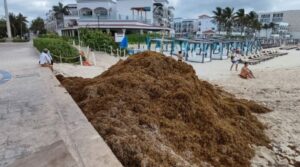
Sargassum in Mexico
Sargassum is a marine macroalgae that, in recent years, arrived in alarming quantities on the coasts of the Mexican Caribbean, especially on the beaches of Quintana Roo such as Cancun, Playa del Carmen, and Tulum. Its massive accumulation affects both the marine ecosystem and the local economy, by deteriorating water quality, releasing harmful gases, and driving away tourism.
Mexico is addressing this issue with daily cleaning operations, led by the Secretary of the Navy and local workers. During high season, more than 1,000 tons can be collected weekly, posing a logistical and environmental challenge for their final disposal.
Faced with this scenario, initiatives have emerged that seek to transform sargassum into useful products such as fertilizers, ecological bricks, cosmetics, and biofuels. These solutions not only help reduce its negative impact but also propose a new sustainable vision to harness it as a resource.



