



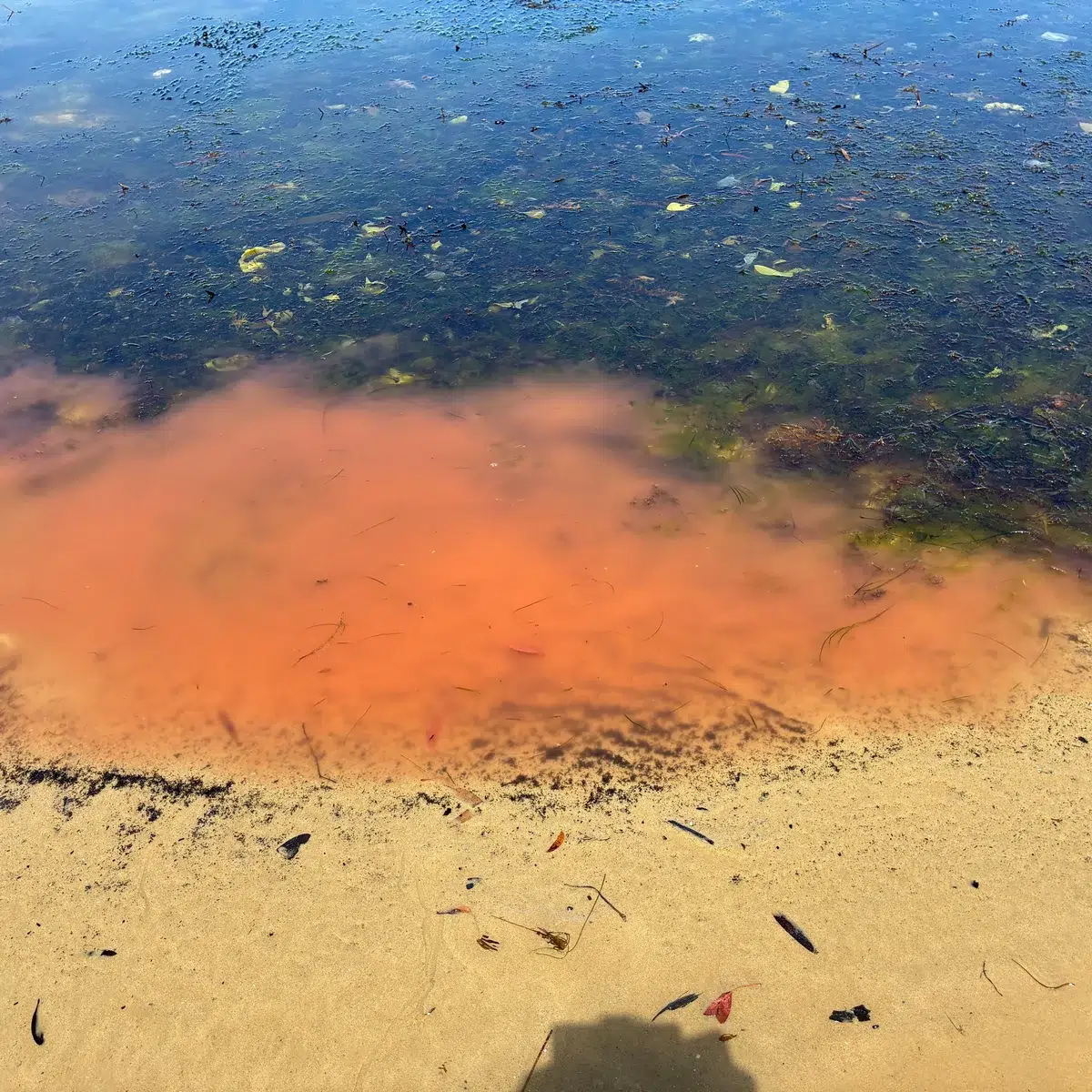
Last Friday, a pinkish viscous substance appeared on remote beaches in southern Tasmania, causing alarm among authorities, scientists, and environmental organizations.
The phenomenon was first detected in Randalls Bay, about 60 km south of Hobart, and then in areas such as Little Roaring Beach, the D’Entrecasteaux Channel, and Little Taylors Bay, according to reports from The Guardian and The Northern Daily Leader.
Local residents reported the presence of this “slime” from early in the day. Teams from the Department of Natural Resources and Environment Tasmania collected samples for analysis, although it has not yet been specified when the results will be available.
Possible algae bloom
A spokesperson for the Tasmania Environmental Protection Authority linked the event to possible algae blooms, natural processes influenced by fluctuations in nutrients, temperature, precipitation, or light. The spokesperson noted that these episodes have increased in frequency recently, driven by pollution and climate change.
While most blooms are harmless, some can significantly alter marine ecosystems when dinoflagellates —phytoplankton that usually acts as an “ocean cleaner”— multiply rapidly.
The scientific hypothesis
The preliminary explanation points to the species Noctiluca scintillans, known as “sea sparkle” for the glow it can generate in the water. According to estuarine ecologist Faith Coleman, numerous red tides have been recorded in Tasmania in recent times.
Coleman indicated that this dinoflagellate rarely produces dangerous toxins but consumes small invertebrates and fish eggs, increasing the risk for fish and crustaceans. She also explained that these tides usually occur after other bloom events or massive spawnings, such as those of salmon or coral, destabilizing the marine ecological network.
Risks to fauna and human health
The potential impact on marine fauna and human health keeps experts on alert. In South Australia and South Africa, there have been reports of massive marine animal deaths and mild human discomfort —such as eye irritation and tingling sensation— although no acute toxicity risks have been confirmed.
Marine scientist Lilly Henley, from the organization Neighbours of Fish Farming, reported experiencing “a tingling sensation on arms and face” after contact with the affected water. She also reported the appearance of dead octopuses on the coast. Henley noted that the bloom grew considerably in the last 12 hours and attributed the worsening to the nutrient input from the salmon aquaculture industry.
Institutional reactions
The Bob Brown Foundation warned of a possible “environmental emergency” and called on the Premier of Tasmania, Jeremy Rockliff, for immediate measures. The leader stated that “there is no evidence so far of a link to the salmon industry” and emphasized the need for a thorough investigation before drawing conclusions.
Rockliff defended the social and economic value of the island’s waterways and the importance of ensuring their sustainable use.
A growing challenge
Experts warn that these dinoflagellate blooms represent a growing challenge for fisheries sustainability and the health of coastal areas, both in Tasmania and other regions.
The advance of these phenomena compromises marine biodiversity, adds pressure on local communities and fragile ecosystems, and reinforces uncertainty in the face of increasingly favorable conditions for their proliferation.


