



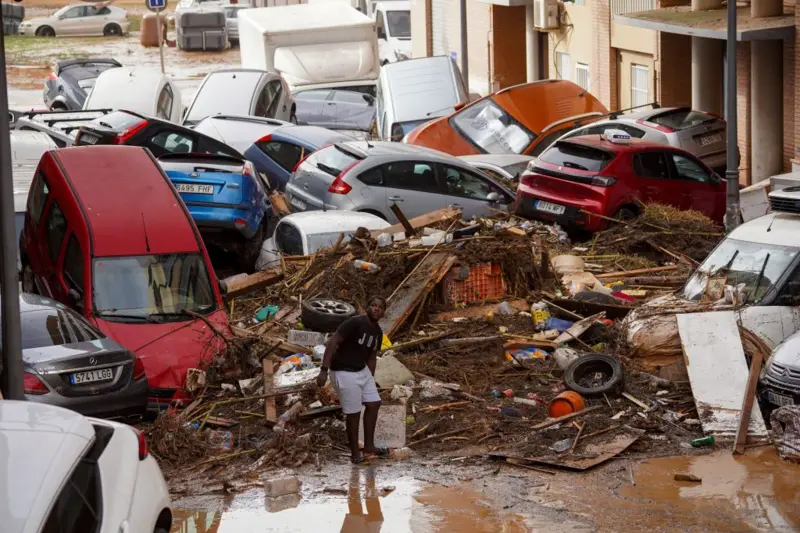
In Turís, in the province of Valencia, the weather station recorded 184 liters per square meter in a single hour during the DANA. This is the highest figure ever measured in Spain, a record that redefines the limits of extreme rainfall.
Additionally, in just 15 hours a total of 771 liters per square meter accumulated. Therefore, the magnitude of the episode surprised even the scientific community specialized in severe atmospheric phenomena.
However, the most unsettling aspect was not just the intense punctuality, but the territorial extent of the impact. The storm affected large areas of the western Mediterranean with unusual violence.
In this scenario, researchers from Spain, Italy, and Switzerland analyzed the phenomenon to understand why it was so destructive. Thus, the focus shifted from the immediate emergency to the structural causes.
Scientific journey to the pre-industrial era to measure the impact of climate change
The team, composed of specialists from the University of Valladolid, the CSIC, and the State Meteorological Agency, compared the DANA of 2024 with the climatic conditions of the 1850-1900 period.
That interval, considered the pre-industrial era, precedes the massive burning of coal, oil, and gas. Consequently, it represents a scenario with lower concentrations of greenhouse gases. The results, published in the Nature scientific journal, indicate that for every degree of global warming, rainfall intensified by 20%. Thus, the storm was amplified by a warmer atmosphere.
Additionally, extreme rainfall exceeding 180 liters per square meter was 22% more intense and extended over 55% more territory than in a scenario without warming. Therefore, the researchers conclude that the current climatic context enhanced the event.
Currently, the global average temperature is almost 1.5 °C higher than 150 years ago. This increase acts as an energy catalyst for severe phenomena.

What is a DANA and why can it become more destructive?
A DANA, or Isolated Depression at High Levels, is a low-pressure system that separates from the general atmospheric circulation. It forms when a pocket of cold air at high altitude becomes isolated and comes into contact with warm and humid air at the surface.
This thermal contrast favors instability and the formation of intense storms. In the Mediterranean, where the sea provides additional moisture, rainfall can be torrential.
However, global warming increases the air’s capacity to retain water vapor. Consequently, when a DANA is triggered, it has more energy and generates more abundant and violent rains.
Researchers warn that in the western Mediterranean these systems evolve into more virulent configurations. Therefore, they emphasize the urgency of strengthening urban planning and adaptation strategies in the face of increasing risks.


