



An impactful natural phenomenon in Australia, on a beach, surprised tourists and local swimmers. The sea was practically dyed in a fluorescent blue color, and the images quickly went viral on social media around the world.
As explained by scientists, the beaches of St. Kilda were the scene of the appearance of bioluminescent algae.
This spectacle, uncommon in the Port Phillip Bay, “covered” the water in a brilliant blue color, attracting crowds to witness the hypnotic glow that ripples on the shore.
The mystery of the glow: what are Noctiluca scintillans algae, the natural phenomenon that impacted Australia?

The phenomenon is caused by the marine algae Noctiluca scintillans, known for its ability to emit light. Marine biologist Richard Pensak, from Earthcare St Kilda, explained to the media that he first observed a pink cloud during the day and, upon returning at night, found a crowd enjoying the show.
Pensak described the phenomenon as something that “simply enlightens people“. However, he also pointed out that its proliferation is linked to the increase in ocean temperatures.
According to Professor Shauna Murray, a marine biologist at the University of Technology Sydney, these algae have proteins called luciferase. These proteins are responsible for their ability to glow in the dark.
A more frequent phenomenon
The phenomenon has become more frequent on Australian coasts since the 1990s, and due to the warming of the waters, it has expanded southward, reaching even Tasmania.
Although the glow is an impressive sight, the proliferation of Noctiluca scintillans can also have negative effects on the marine ecosystem, as it generates high levels of ammonia that can be irritating to fish.
“It’s like being inside a moving galaxy,” described Ryan Abramowitz, a local writer and illustrator who approached on Monday night to see the phenomenon.
Abramowitz recounted that he entered the water despite the low temperatures to “immerse himself in the amazing and rhythmic trails of light.”
He claims that although he had seen bioluminescent algae before in Sydney and Bali, he had never witnessed anything as intense in Melbourne. “It was definitely the most cosmic and magical experience, an exquisite opening to the first day of spring,” he said.
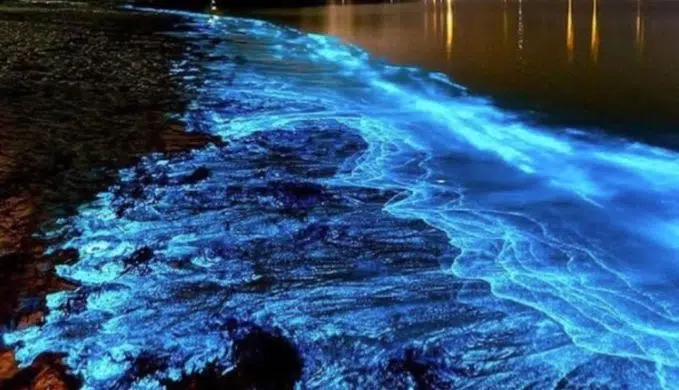
This phenomenon, described by some witnesses as “amazing” and compared to “bright galaxies spinning and swirling,” is a reminder of the beauty and complexity of nature, and how climate change is altering marine ecosystems.
Where are the algae found?
The proliferation of Noctiluca scintillans occurs in a wide variety of marine environments worldwide, mainly in coastal waters, estuaries, and shallow areas of the continental shelf.



