



An international team of researchers described a new species of ghost fish in the Journal of Fish Biology: Solenostomus snuffleupagus.
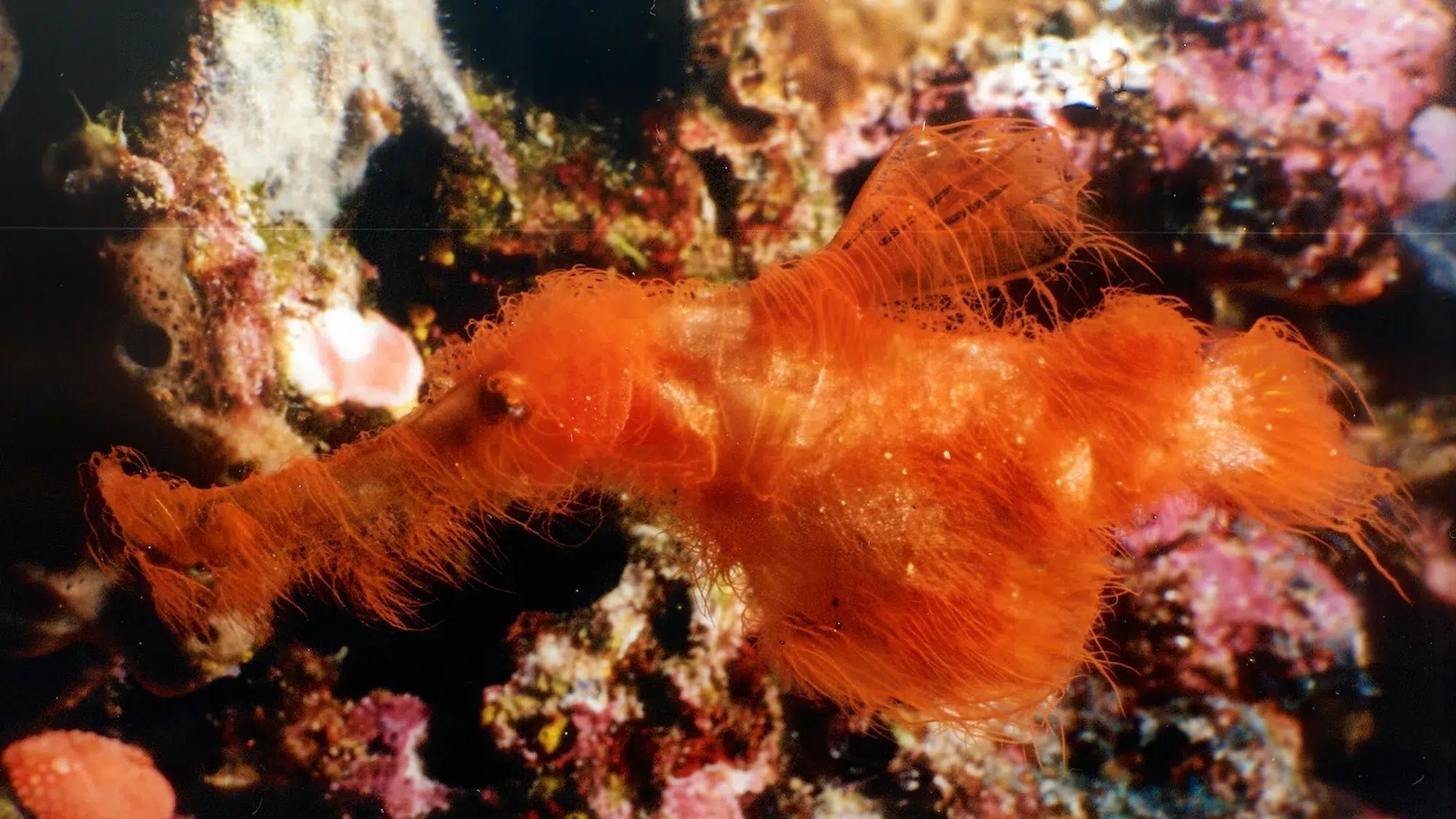
Detected in the Great Barrier Reef and in other parts of the Pacific such as Papua New Guinea, Fiji, New Caledonia, and Tonga, this marine animal is characterized by its ability to mimic red algae thanks to its body covered with long, thin filaments.
Its disordered and almost invisible appearance makes it a true master of camouflage, capable of going unnoticed even by experts.
Distinctive Traits
- Short and deep body in the front part.
- 36 vertebrae, more than other species in the same group.
- Two anchor-shaped bones in the dorsal and anal fins.
- Variable colors: predominantly orange and red, with purple variants and an isolated case in green.
- Adult size: between 18 and 34 mm.
The fish moves by imitating the sway of aquatic algae, reinforcing its camouflage.
Identification Tools
Researchers employed advanced techniques:
- Computed microtomography (micro-CT) to observe internal structures without damaging the specimens.
- Analysis of mitochondrial DNA COI, which revealed a 22% genetic difference compared to closely related species such as Solenostomus paegnius.
Citizen Science as an Ally
Photographs and records from divers on scientific platforms and social networks were essential for locating specimens in habitats difficult to sample. This contribution allowed for the expansion of the known distribution of the species and confirmed its uniqueness.
Unexpected Diet
For the first time in this group of fish, the skeleton of another small fish was found inside the stomach of a specimen.
Until now, it was thought that ghost fish only consumed crustaceans, which expands the knowledge about their diet and their role in the food chain.
Ecological Importance
The discovery of Solenostomus snuffleupagus demonstrates that reefs and macroalgae are refuges for still unknown species. The scarcity of specimens in museums is due to their camouflage ability and confusion with similar species.
Researchers propose combining more specific sampling with genetic analysis to better understand the connectivity of their populations and assess whether conservation measures are needed.
The official recognition of Solenostomus snuffleupagus raises the known species of ghost fish to seven and confirms that there are still hidden animals in ecosystems studied for decades. This finding underscores the importance of combining new technologies and citizen participation to solve mysteries of marine biodiversity.


