



A collaborative project among various institutions has resulted in the presentation of a Technical Guide for the Design of Urban Pruning Composting Plants.
This document stems from over two years of joint work between the INTI (National Institute of Industrial Technology), INTA (National Institute of Agricultural Technology), the Faculty of Agricultural Sciences of UNC (National University of Córdoba), and the Cooperative Proyecto Hormiga.
The primary objective of this guide is to provide a detailed and practical tool that addresses the multiple aspects necessary to convert pruning waste into valuable resources, using composting as a central valorization strategy.
The proposed management model has not only proven to be effective in preventing the accumulation and waste of residues but has also generated employment, boosted local economies, and strengthened environmental resilience in locations like Unquillo.
By reintegrating pruning compost or organic matter into the soil, it directly contributes to carbon capture, helping mitigate climate change and improve water retention in the soil profile.
The guide comprehensively addresses various key points:
- A diagnosis and characterization of urban green waste (UGW) and pruning waste (PW), including real data from the Sierras Chicas corridor.
- Guidelines for composting plant design, with technical criteria on location, size, processes, and equipment.
- Strategies for waste treatment and utilization, with recommendations to achieve optimal mixes, monitor the process, and control compost quality.
- Technical fact sheets and practical tools designed for operators and technicians in charge of managing green waste.
In discussing the project, Violeta Silbert, a technician from the National Institute of Industrial Technology who accompanied the development of the guide, emphasized a fundamental premise: the best pruning is that which is not done, meaning when the tree is allowed to grow naturally.
“I think that is the main direction we should take regarding pruning waste, and it’s the same we say about waste in general.
The best waste is the one that is not generated; once it is generated, we manage it, and that’s where we come in with this guide,” explained Silbert.
Proyecto Hormiga’s Experience in Sierras Chicas
Ariel Herrera, a member of Proyecto Hormiga, mentioned that their work in Sierras Chicas began around 2018.
At that time, they presented a project to the municipality for the use of pruning waste, which initially had a more investigative focus.
“While being inside the waste treatment plant in Unquillo, we started to create products, to visit nurseries, see if the products we had were marketable, until everything worked out well, and the municipality gave us the green light to start working there in the solid waste plant in Unquillo,” Herrera recounted.
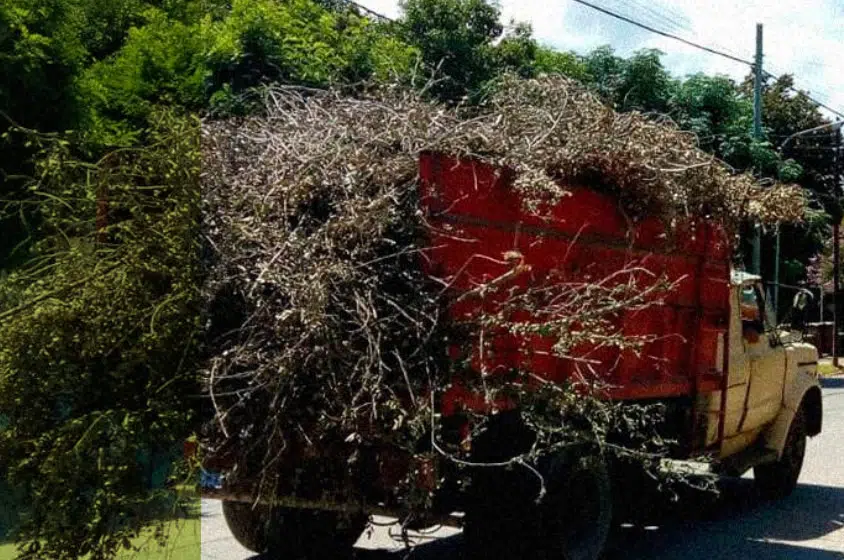
Ariel emphasized that they worked for several years, processing numerous pruning waste trucks. In Unquillo, the daily input of pruning waste is approximately twenty trucks.
“We created a management model, we created a brand, and it was well received by the market. In that sense, we had the opportunity to show that such a bulky waste could be valorized. Organic waste represents about fifty percent of all waste generated here,” he stated.
Silbert, referring to the contribution of INTI, detailed that they monitored piles of chipped pruning compost, which was shredded with municipal machinery and then mixed with other substrates available in the peri-urban area of any city.
Her vision focuses on turning the waste into a resource and promoting local utilization.
“It is a project that, in addition to having this interinstitutional, transdisciplinary way of working, formal and non-formal education, working together to produce a product, has local application, local anchoring.
These amendments can be applied locally, either for the improvement of urban green spaces, local food production, proximity, such as a green belt, many cities bring their food from very distant places, concentrator markets are concentrated in large cities, and that’s where the food comes from,” Silbert explained.
In that sense, she added that they posed the question of why not have local production amendments for local food supply.
“We managed to standardize, evaluate and co-build knowledge through a dialogue of knowledge between all these actors, and it allowed us to design a plant for the Municipality of Unquillo that became an experience to be observed and replicated, because the guide, with its core being chapter 3, which I invite you to look at, based on the experience we had working on the plant, we designed the Unquillo plant, which was not built but is currently in the design stage.
A series of recommendations were developed from that design that allows, through technical fact sheets, procedures, any person with technical capacity to take this guide and design the plant according to their locality,” Silbert concluded.
Importance of the guide and access to the document
The relevance of this guide lies in its ability to make us rethink the management of urban pruning not only as a logistical challenge but as an opportunity to strengthen local circular economies, reduce emissions, generate compost for green spaces, and promote green jobs.
This freely accessible document is proposed as an essential technical manual reference for local governments, cooperatives, environmental professionals, and any interested organization looking to implement a comprehensive valorization strategy of green waste through pruning composting.

The design of a plant for the production of amendments and substrates covers several key stages:
- a. Repair and start-up of municipal machinery.
- b. Chipping test.
- c. Obtaining the first products.
- d. Distribution in Nurseries.
- e. Planialtimetric survey of the site.
- f. Preliminary design of a PW treatment plant.
If you wish to access the file in its original format and quality, you can download it



