



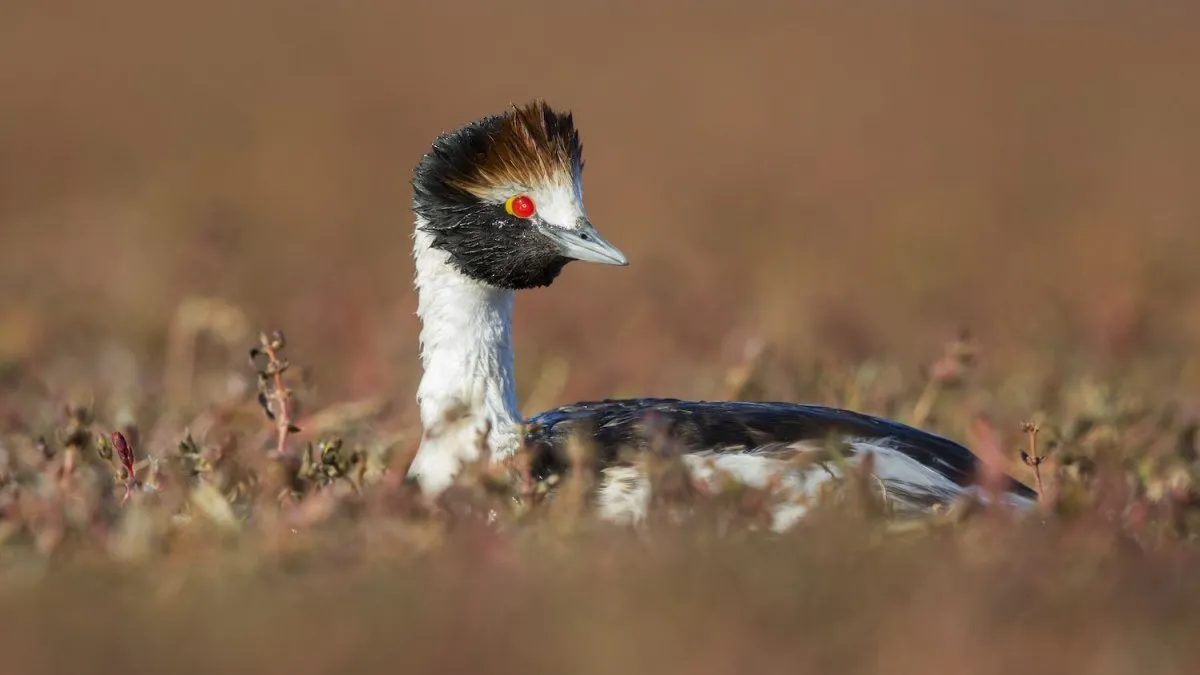
After a decade without reproductive records within the protected area, the hooded grebe (Podiceps gallardoi) has nested again in the Patagonia National Park, in Santa Cruz.
This finding confirms the importance of the park’s creation and represents a key step for the recovery of this endemic species of Argentina, whose current population is estimated at just 700 individuals.
Threats faced by the species
The hooded grebe has suffered a marked population decline due to:
- American mink, an invasive exotic species that preys on nests and adults.
- Kelp gull, favored by resources associated with human settlements.
- Habitat degradation due to human activities.
- Climate change, which alters the weather conditions of the plateau.
The discovery on the plateau
In the lagoon of Lake Buenos Aires, 9 pairs and 9 chicks were recorded. To protect the colony, a team of “colony guardians” set up a camp at 1,400 meters above sea level and maintained permanent surveillance between February and April, facing extreme conditions of cold, wind, and snow.
During the campaign, scientific information was collected on demography, reproductive success, and behavior, in addition to protecting adults and chicks from invasive species.
Conservation strategies
The joint actions between Patagonia National Park and the Hooded Grebe Foundation include:
- Monitoring potential nesting lagoons.
- Surveillance of reproductive colonies.
- Control of exotic species using trained dogs to detect mink traces.
- Use of camera traps and staff patrols to increase response capacity.
Ecological value of La Payunia and the Patagonian plateau
The hooded grebe nests exclusively in plateau lagoons with aquatic vegetation such as vinagrilla (Myriophyllum quitense), which it uses to build floating platforms. During winter, it migrates to the estuaries of the Santa Cruz Atlantic coast.
The protection of these lagoons is vital to ensure the species’ reproduction and maintain the biodiversity of southern Patagonia.
Coordinated work and recent achievements
The conservation of the hooded grebe is the result of a collective effort involving the National Park, the Hooded Grebe Foundation, Biome, Whitley Fund for Nature, CONICET, Aves Argentinas, the Provincial Agrarian Council, and local communities.
One of the most recent achievements was the incorporation of 40,000 private hectares into public domain in 2025, strengthening the area’s protection and ensuring its conservation in perpetuity.
The return of the hooded grebe as a nesting species in Patagonia National Park is a victory for Argentine conservation. This record not only brings hope for population recovery but also highlights the importance of coordinated management between institutions, communities, and producers to protect biodiversity in a context of increasing threats.



