



In a historic decision, the International Court of Justice (ICJ) concluded that Countries that cause climate damage commit an illicit act on the international level and could be forced to financially compensate the countries most affected by climate change.
The ruling, issued as a non-binding advisory opinion, establishes a legally significant interpretation that can guide future decisions worldwide regarding environmental rights and state responsibilities.
The announcement was made during a formal session presided over by Judge Yuji Iwasawa, who stated that climate deterioration caused by greenhouse gas emissions constitutes an “urgent and existential threat”. The ruling was celebrated by environmental organizations, who followed the hearing outside the Peace Palace, the court’s headquarters in The Hague.
Unanimously, the judges declared that the failure to meet international climate commitments is equivalent to an “internationally wrongful act”, and that responsible countries could face full reparations, including restitution, compensation, and satisfaction measures, provided that a direct and verifiable causal relationship is established between the damage suffered and the omission or violation.
Although proving this connection in court is complex, the judges emphasized that it is not impossible.
The case, considered by legal experts as the most significant ever addressed by the ICJ in environmental matters, stems from a request for interpretation submitted by the UN General Assembly, following a mobilization initiated by Pacific students, whose nations are particularly exposed to rising sea levels and extreme climate events.
Climate Change and Its Impact on Human Rights
Among the key arguments of the court, Judge Iwasawa highlighted that the climate must be protected for present and future generations, and that global warming can severely affect fundamental human rights, such as the right to life. The ruling addresses two central questions:
- What is the obligation of States, under international law, to prevent future climate damage?
- What legal consequences do countries face whose emissions have caused serious ecological impacts, especially in vulnerable regions?
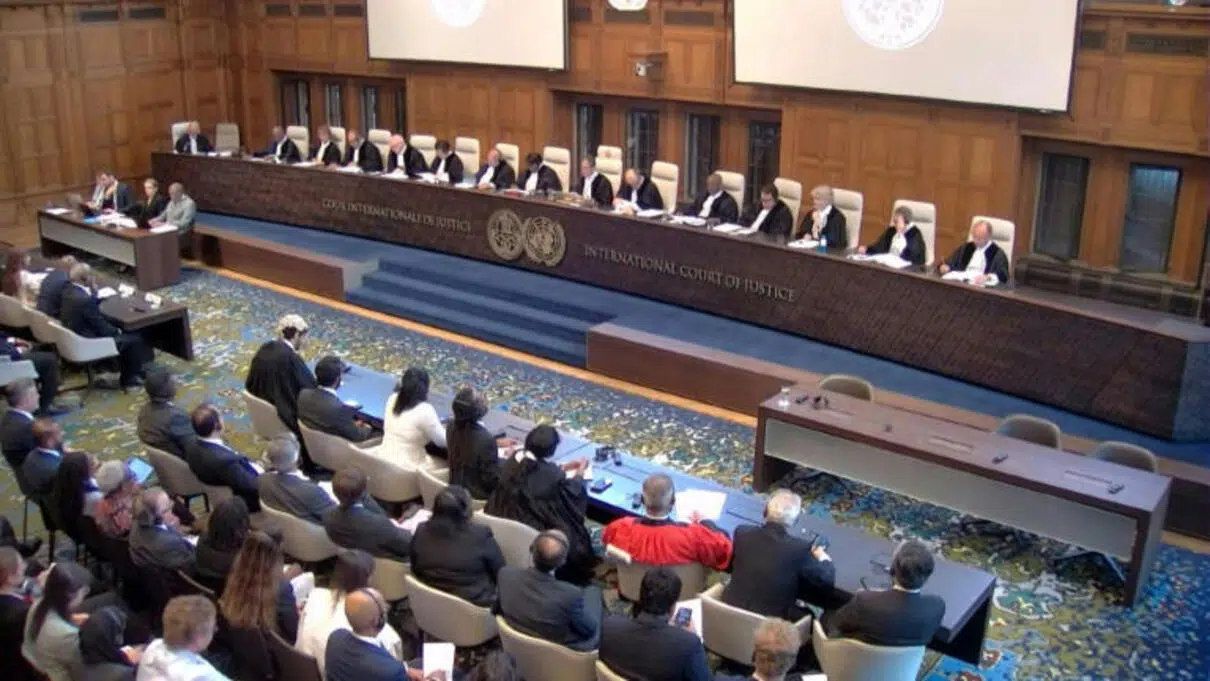
The initiative, driven by the small island state of Vanuatu and supported by over 100 countries and coalitions, aims to hold the most polluting nations accountable for their historical emissions. Vanuatu’s Minister of Climate Change, Ralph Regenvanu, hailed the ruling as a firm and hopeful resolution.
For the UN Secretary-General, Antonio Guterres, this is “a victory for the planet and for the youth demanding climate action”. The campaign, which started in a university classroom, was led by Vishal Prasad, who praised the ruling as “a strong tool to hold power accountable”.
While not legally binding, the ICJ’s advisory opinion establishes a legal basis that could support future legal actions in international courts, particularly in cases involving ecological damages caused by carbon emissions.
Global Reactions and Challenges for Climate Justice
The resolution faces divergent perspectives. Small and vulnerable states demand that historically polluting nations finance compensatory measures, while the most developed economies reject this possibility as unacceptable in diplomatic circles.
The United States government, which withdrew from the Paris Agreement during the administration of Donald Trump, responded moderately. According to a State Department spokesperson, the country will evaluate the content of the ruling in the coming days and weeks.
Meanwhile, experts like David Boyd, former UN Special Rapporteur on Human Rights and the Environment, described the ruling as a “historic victory for global climate justice”.
The pronouncement of the International Court of Justice marks a turning point for climate governance.
While it does not automatically compel states to pay compensation, it provides a legal basis to demand accountability from those who fail to meet their climate commitments, expanding the possibilities in terms of international environmental law.


