



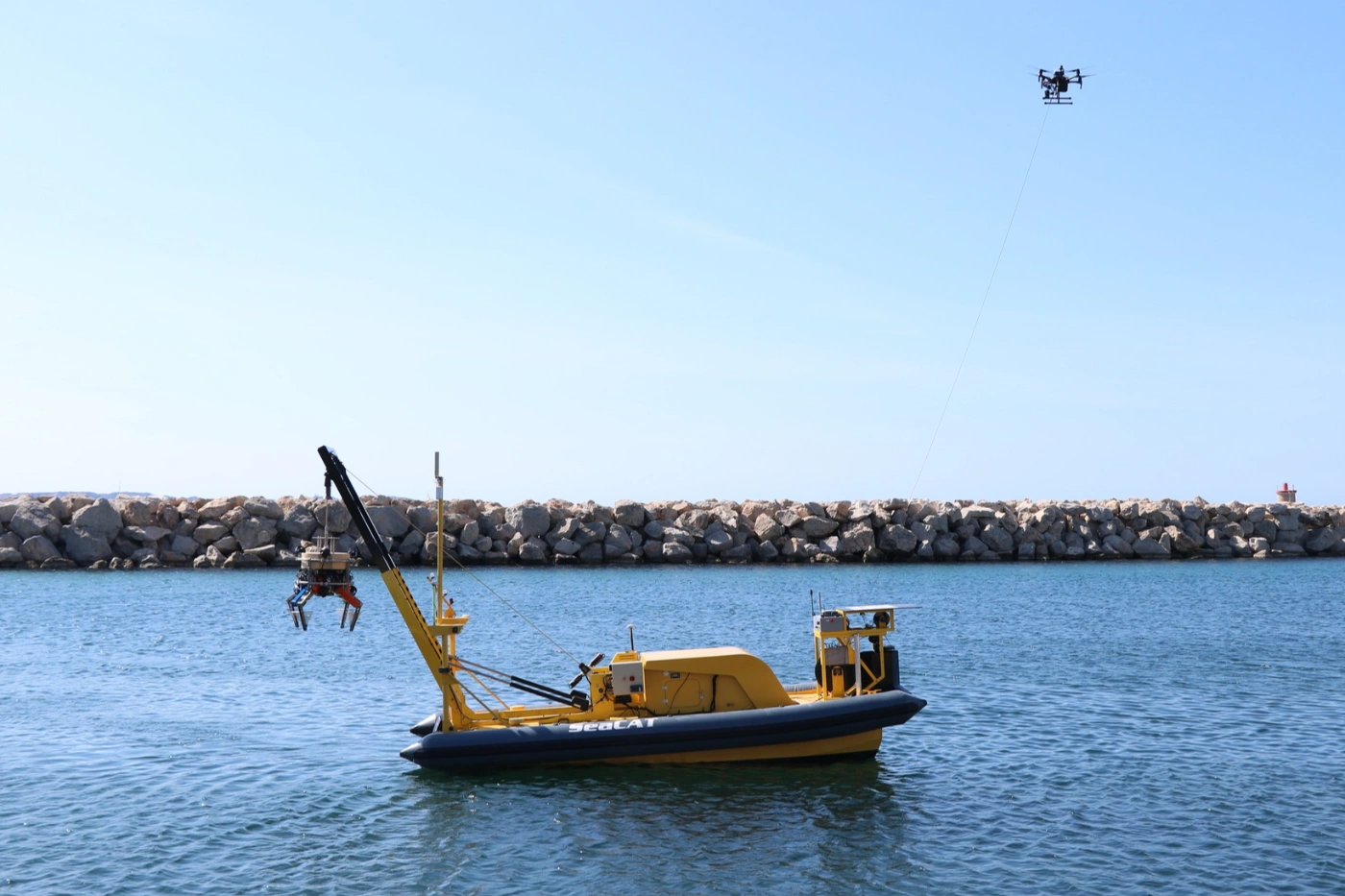
The Technical University of Munich (TUM) presented in September 2025, as part of the SeaClear2.0 project, an autonomous spider-like underwater robot designed to remove trash from the seabed more safely and precisely than traditional operations. The demonstration took place in the port of Marseille, an environment where waste accumulation is critical.
The system is of particular interest to Spain, where the pressure on beaches, docks, and port seabeds generates environmental and economic problems every year, affecting biodiversity, tourism, and the maintenance of coastal infrastructures.
The problem of plastic pollution
Marine litter not only floats: it also accumulates on the seabed. A study estimates that between 3 and 11 million metric tons of plastic reside on the ocean floor, with significant concentrations near the continents. Removing objects like nets, tires, or scrap is a task of long-term environmental management, beyond symbolic gestures.
SeaClear2.0: a collaborative team
The project is not limited to a single robot but to a coordinated system that combines:
- An unmanned vessel.
- An aerial drone.
- Several marine vehicles capable of locating, classifying, and recovering waste.
The European Commission (CORDIS) describes the approach as a collaborative system that operates from the air, the surface, and underwater, supported by machine learning to identify and map trash before removing it.
Safety and precision
The goal is to reduce the exposure of divers in complex operations, especially in conditions of low visibility, currents, or depth. TUM’s underwater robot stands out for its four-fingered claw, capable of applying up to 4,000 newtons and handling objects up to 250 kilos, regulating the force to avoid breaking fragile materials.
The difference compared to a traditional crane lies in the intelligent decision-making: the AI generates a 3D representation to choose the safest grip point, minimizing bumps and breaks and reducing the risk of releasing microplastics during the operation.
Demonstration in Marseille
The public exhibition of the system was held on September 16, 2025, bringing together technological and academic partners. The choice of port was not accidental: docks concentrate human activity and internal currents that accumulate trash over the years.
Relevance for Spain
The impact is twofold:
- Ports and coastal urban areas are the main focal points of waste accumulation, where this type of robot is most useful.
- The system not only cleans but also generates data on what waste appears, where, and how often, a key input for local policies and port management.
Open questions
Neither TUM nor the project has yet detailed a commercial deployment schedule in Spanish ports or the cost per operation. Adoption will depend on funding, public procurement, maintenance, and safety protocols.
Prevention and local experiences
Robotics helps but does not replace prevention. In Spain, initiatives like Proyecto LIBERA insist on cutting the flow of waste from land. Additionally, programs like Upcycling the Oceans and Mares Circulares already document seabed cleanup campaigns, with participation from local actors. The entry of systems like SeaClear2.0 can strengthen this ecosystem, especially where diving risks and costs are high.
SeaClear2.0 represents a technological advance with the potential to transform marine waste management in Europe. For Spain, its application in ports and coastal areas can be key to combining cleaning, prevention, and monitoring, integrating data and operations into a broader environmental protection strategy.



