



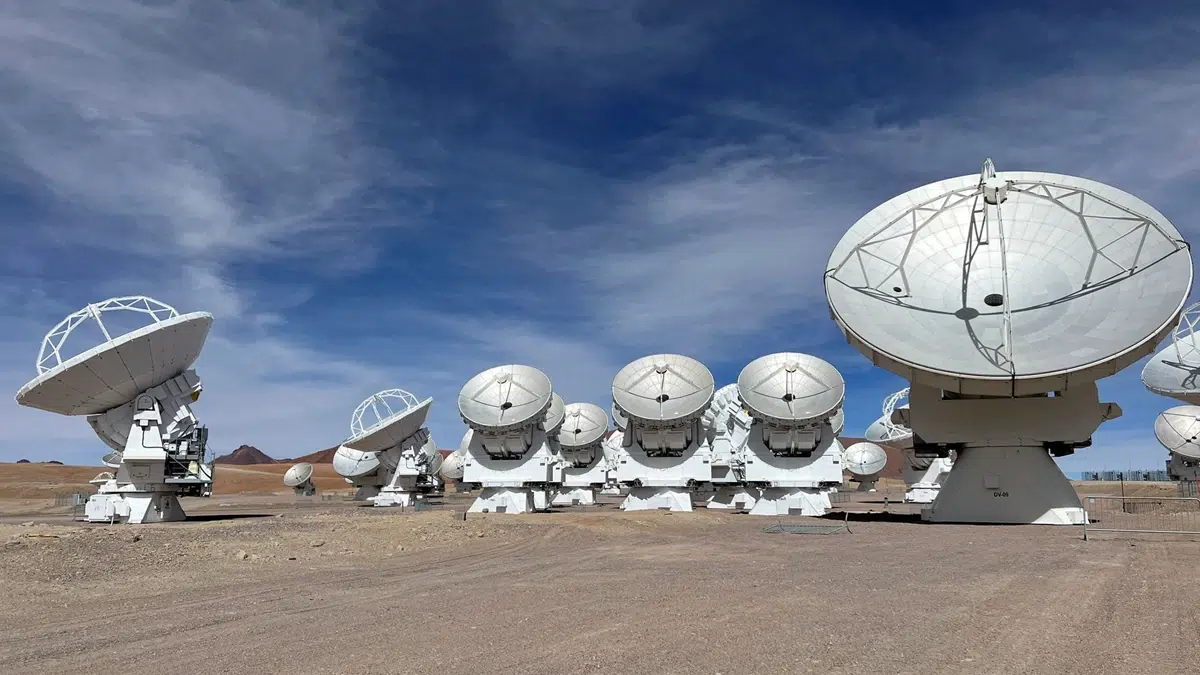
South America is home to the largest astronomical observatory on the planet, located in northern Chile. It is the Atacama Large Millimeter/submillimeter Array (ALMA), installed on the Chajnantor Plateau, at more than 5,000 meters above sea level in the Atacama Desert.
This scientific complex has become a world reference for its observational capacity and the advances it has enabled in the study of the universe.
ALMA: a giant telescope in the Atacama Desert
ALMA operates thanks to the joint participation of 66 precision antennas, which function as a single giant telescope. Its location is strategic: the atmosphere of the Atacama Desert is ideal for capturing millimeter and submillimeter wavelengths, invisible to other instruments.
The combination of signals from all the antennas simulates a telescope with a diameter of up to 14 kilometers, providing a resolution up to 10 times sharper than the Hubble Space Telescope.
Among its most notable achievements are:
- Advances in understanding the formation of planetary systems.
- Detection of chemical components in the universe.
- Contribution to the first image of a black hole, the supermassive one in the M87 galaxy.
The future: the Extremely Large Telescope (ELT)
Although ALMA currently holds the position of the largest observatory in the world, it will soon be surpassed by the Extremely Large Telescope (ELT), under construction on Cerro Armazones, also in the Atacama Desert.
This project by the European Southern Observatory (ESO) will be the largest optical and infrared telescope in the world once operational. Its mission will be to advance research in areas such as dark matter, galaxy formation, and the search for life on other planets.
Main features of the ELT
The ELT will feature a revolutionary design:
- Primary mirror: diameter of 39.3 meters, composed of 798 hexagonal segments of SCHOTT ZERODUR® glass-ceramic, functioning as a single mirror of 978 m².
- Light gathering capacity: millions of times more than the human eye, allowing observation of extremely faint objects.
- Secondary mirror: convex, 4.25 meters, the largest ever built.
- Adaptive optics: the fourth mirror (M4) uses 8,000 actuators that adjust its surface up to 1,000 times per second, correcting atmospheric distortions.
- Image stabilization: the fifth mirror (M5) compensates for vibrations to obtain sharper images than those of space telescopes.
- Scientific instruments: spectrographs and cameras that will operate in the visible and infrared spectra.
- Protective dome: a structure 80 meters high that will shield the telescope from the extreme conditions of the desert.
Chile, the world capital of astronomy
The combination of ALMA and the future ELT consolidates the Atacama Desert as one of the most important places in the world for astronomy. Its clear skies, low light pollution, and altitude make it a unique environment for observing the universe with unprecedented precision.
The ALMA observatory has already marked a milestone in the history of astronomy, enabling fundamental discoveries about the origin of life and the structure of the cosmos. With the arrival of the ELT, Chile is poised to lead a new era of space exploration, offering humanity tools capable of answering questions about dark matter, exoplanets, and galaxy formation.



