



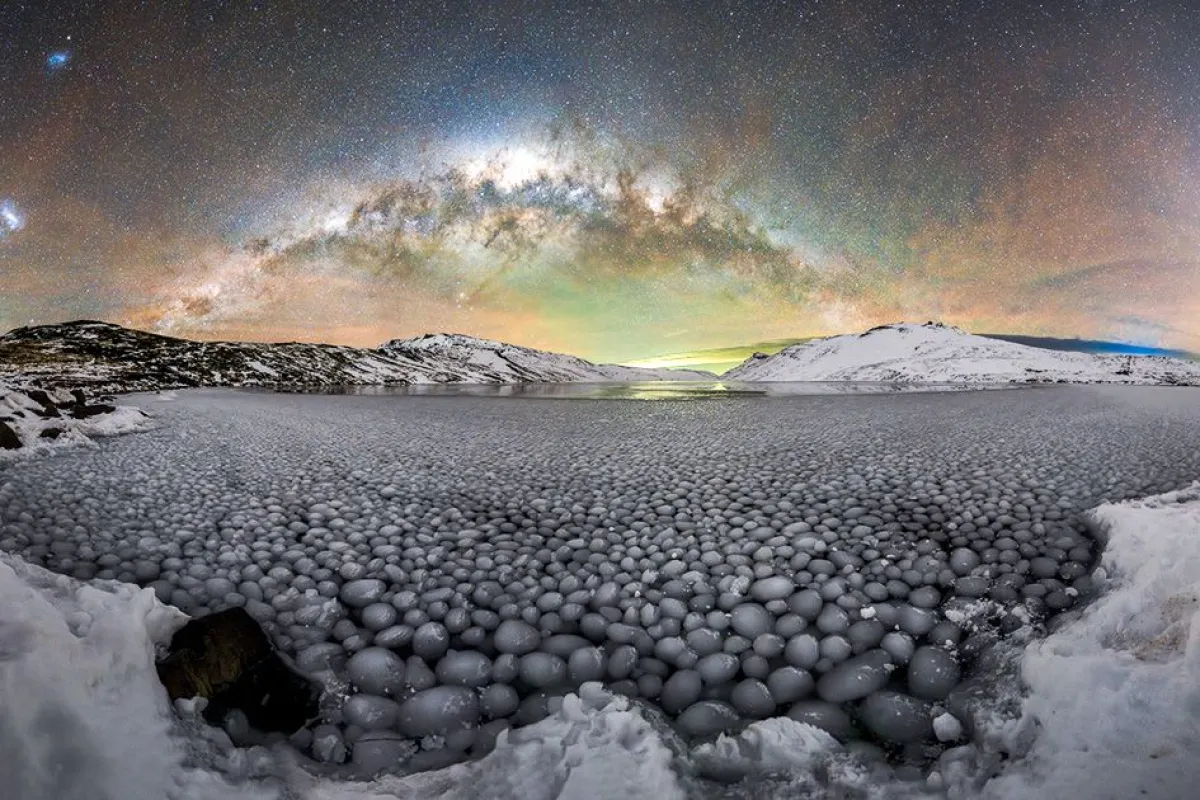
The Laguna Melliza Superior, located in Caviahue-Copahue (Neuquén), surprised scientists, tourists, and local residents by appearing covered with thousands of perfectly rounded ice spheres.
This phenomenon, known as ice balls, was captured by photographer Alejandra Heis using a 180-degree nighttime panoramic technique, immortalizing a unique landscape: a mirror of water transformed into a field of frozen spheres under a clear sky.
The scene became even more striking by coinciding with exceptional astronomical conditions: the Milky Way, the Magellanic Clouds, and an intense reddish and greenish airglow generated by solar activity.
How Ice Spheres Form
Specialists explained that these structures require very precise environmental conditions:
- Subzero temperatures: the area recorded -3 °C.
- Water on the verge of freezing: the lake maintained liquid water on the surface.
- Strong waves and wind: which add concentric layers of ice around an initial core.
The process begins with snowflakes or frost falling on the water. The wind and waves shape the layers until compact spheres form, floating and accumulating on the surface.
Ephemeral Phenomenon and Recommendations
Park rangers warned that these types of formations are ephemeral: a heavy snowfall can quickly bury them.
Therefore, they asked tourists to take extreme care and avoid walking on the fragile structures to preserve the natural spectacle.
Extreme Cold in Argentina
The appearance of the ice spheres is linked to the polar wave affecting the country, caused by Antarctic air masses and polar winds. Its impacts include:
- Freezing of rivers and lakes: in Santa Cruz, temperatures can drop below -20 °C.
- Meteorological frosts: covering fields and vegetation with white frost in the center and north of the country.
- Mountain snowfalls and white winds: snowstorms with zero visibility in the Andes mountain range.
- Thermal inversion: cold air trapped in valleys generating frozen fog.
- Sleet and soft hail: solid precipitation in unusual areas of the Pampas region and the Buenos Aires conurbation.
Scientific and Touristic Value
The ice sphere phenomenon is not only a visual spectacle but also an object of study for meteorology and climatology.
Its rarity in Patagonia makes it a tourist and scientific attraction, reinforcing the importance of conserving high mountain ecosystems in the face of climate change.
Moreover, this type of event contributes to scientific dissemination, bringing the population closer to concepts such as capillarity, freezing, and the interaction between wind, water, and temperature. The viralization of images on social media also helps raise awareness about the fragility of Patagonian ecosystems.
The appearance of thousands of ice spheres in Laguna Melliza Superior is a reminder of nature’s ability to surprise and create unique landscapes.
Although ephemeral, this phenomenon reflects the interaction between extreme cold, wind, and water, adding to the list of unusual postcards that Patagonia offers to the world.
Its observation and study allow for a better understanding of climatic processes and the appreciation of the region’s natural wealth.


