



The Rada Tilly Municipality, located in the province of Chubut, is committed to food self-sufficiency with the creation of the Municipal Agroecological Center. This place was designed with the aim of strengthening agroecological production in the province, as well as promoting food self-sufficiency.
Following the approval of the ordinance passed in February of this year, the site is already in the conditioning stage. Over the past few weeks, municipal workers from the municipality worked on leveling the ground, installing lighting, painting, and afforestation.
These tasks are part of the first phase of the project that will take place west of Plaza Ara San Juan, on a plot of approximately 2,000 square meters. In addition to the mentioned works, the installation of two greenhouses for the municipal nursery will also be carried out, which will be used for the production of forest species, ornamentals, and seedlings.
Likewise, a municipal composter will be built, where residents can deliver the compostable fraction of their household waste. A noteworthy aspect is that the project will be accompanied by a volunteer program, which opens the possibility of implementing a collection system for compostable waste throughout the city.
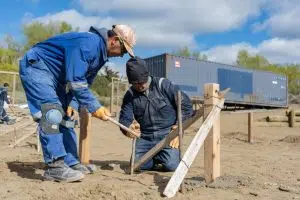 The town of Rada Tilly in Chubut is working on the construction of a Municipal Agroecological Center. Photo: Rada Tilly Municipality.[/caption>
A center dedicated to environmental preservation
In addition to the improvements and greenhouse installations, the center will have small cultivation units under an intensive organic biointensive production system, which will be intended for self-sufficiency, as well as for the training of all interested parties. The place will be divided into parcelled terraces, where community farmers will have the possibility to produce associatively.
Beyond the facilities, the site will function as a space for environmental education, as courses on organic gardening, technical training in agroecological production, workshops, and training sessions providing practical tools for those who wish to join the initiative will be held there.
A place for the community
The goal of the Municipal Agroecological Center is to form a community group of farmers who, working together with the municipality, can organize the availability and sale of part of the crops generated on-site. In this way, income will be generated to contribute to the maintenance of the space.
In summary, this place is conceived as a community space open to the community, whether they be residents, institutions, or organizations wishing to get involved in sustainable production. In addition to strengthening local food production, the project also aims to promote responsible habits in waste management and in environmental care.
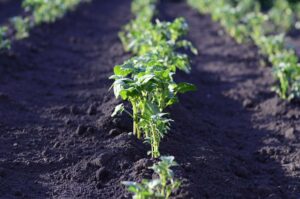
What is the function of agroecological centers?
Municipal agroecological centers are spaces created by local governments to promote the production of healthy food through sustainable practices. There, the responsible use of natural resources is promoted, avoiding agrochemicals and favoring agroecological techniques that respect the earth’s cycles.
These centers also function as training and outreach points. Residents, producers, and students participate in workshops where they learn about composting, crop rotation, natural pest management, and conservation of native seeds, strengthening food sovereignty.
In addition to their productive and educational function, agroecological centers play an environmental and social role. They help restore soils, promote biodiversity, and generate local food, reducing the carbon footprint. At the same time, they strengthen community networks and provide job alternatives in line with a sustainable development model.



