



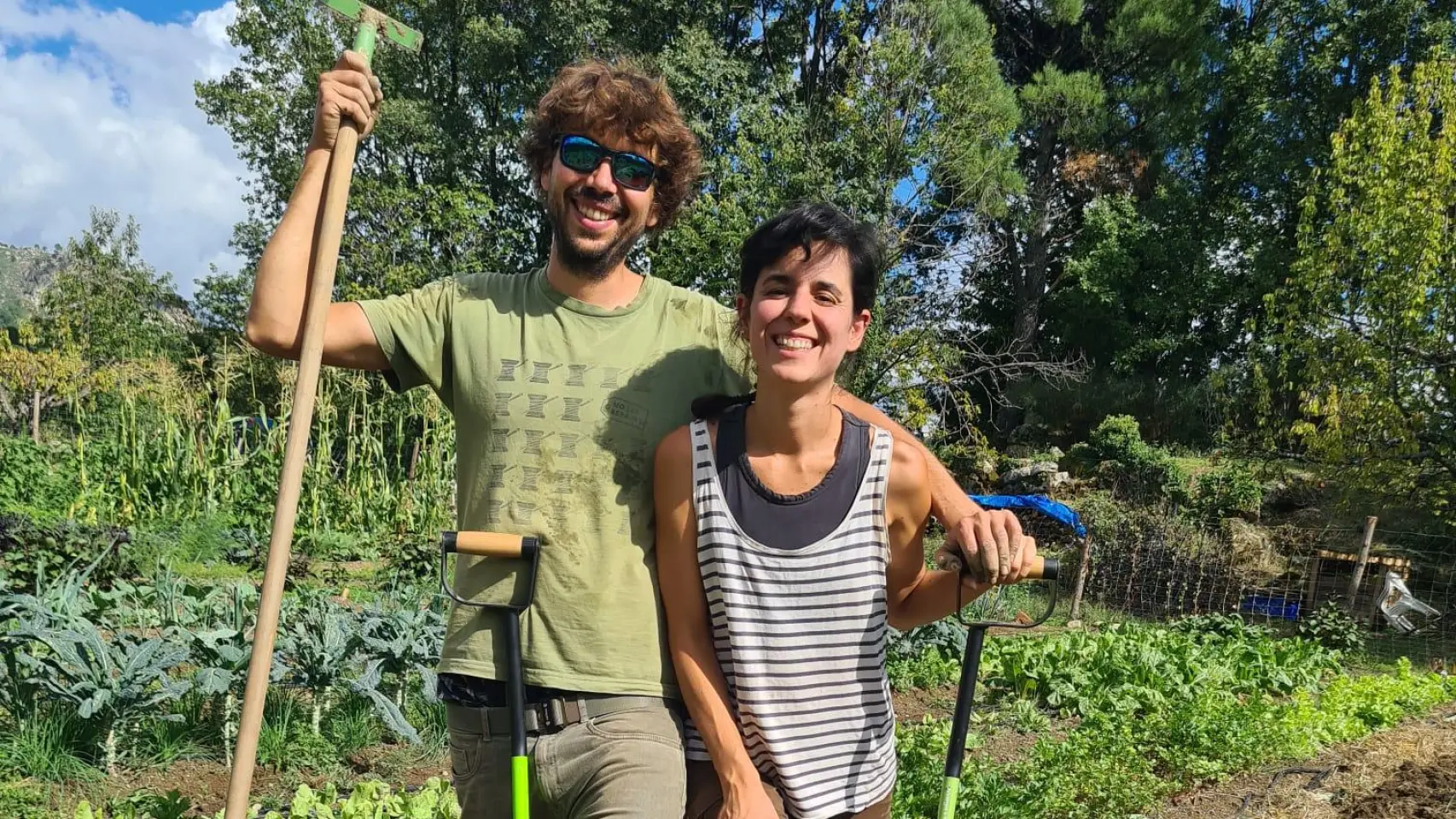
In 2022, Eva Ardao, a natural environment engineer specializing in conservation, and Erik Wenzel, a chef and food technologist, decided to transform their connection with the land into an agroecological project.
They left Madrid and Hamburg to settle in El Hornillo, a small municipality on the southern face of the Sierra de Gredos, where they founded Tierra Campesina, a micro agroecological farm that advocates for manual cultivation, biodiversity, and direct sales.
Cultivating in Harmony: Health, Tradition, and Regeneration
Tierra Campesina is based on principles of regenerative organic agriculture, where soil, water, and biodiversity are treated as living systems. Eva and Erik grow seasonal vegetables, infusions, and ancient varieties adapted to the local microclimate, without heavy machinery or synthetic chemicals.
“Human health depends on the health of nature,” they affirm. Therefore, they avoid the use of tractors, keep the soil covered with living plant matter, and choose seeds that respect the ecosystem’s cycles.
From the Kitchen to the Garden: A Comprehensive View on Food
Erik, with experience in gastronomy and nutrition, noticed that the quality of food deteriorates due to the use of processed foods and agrochemicals. Eva, from conservation biology, questions the division between protected and exploited territories, proposing production in balance with biodiversity.
Both trained in a self-taught and collaborative manner, working on rural projects and studying biointensive agriculture techniques.
Challenges of the Countryside: Land, Bureaucracy, and Market Access
Although the agroecological project is progressing, they faced structural difficulties:
- Access to land: after an initial grant, it took them a year and a half to find a new plot due to rustic land speculation
- Disproportionate bureaucracy: they must comply with regulations designed for industrial producers
- Limitations in public markets: they have been on a waiting list for over a year to sell at the weekly market in Ávila
- Lack of institutional support: aid for young farmers does not consider agroecological models
Collaborative Networks and Short Circuits
Tierra Campesina is part of Ávila Auténtica and sells at fairs like Madrid Productores, in addition to collaborating with:
- Campo a Través, a micro ice cream shop in San Lorenzo de El Escorial
- Restaurante Caleña, in Ávila, where they organize the monthly event Cuaderno de Campo
- Movimiento Market Gardening, which promotes high-productivity ecological micro-farms in small spaces
A Garden as a Space for Learning and Reconnection
Eva and Erik dream of Tierra Campesina being a living project, capable of feeding families, recovering peasant knowledge, and reconnecting urban people with their natural dimension.
“We want it to be a place where the countryside and the city dialogue, where experiences are shared, the environment is preserved, and a fairer and more resilient food system is built.”
Tierra Campesina not only cultivates food: it cultivates bonds, awareness, and biodiversity. In times of climate crisis and territorial disconnection, this type of initiative demonstrates that another way of producing and living is possible, from respect for the land and commitment to the future.



