



In the coming days, a vast portion of U.S. territory will face the onslaught of an Arctic air mass confronting a gigantic snowstorm.
According to weather forecasts, this cold wave will cause snowfalls and frosts in nearly 30 states, impacting the lives of approximately 160 million citizens.
The National Weather Service (NWS) has anticipated that this “life-threatening cold air front” will gradually advance from the Rockies and the High Plains towards the east of the country starting this Friday. Specialists warn that, in various regions, thermometers will register levels of extreme freezing.
Simultaneously, the NWS reports that snow precipitation is already occurring in areas adjacent to the Great Lakes, covering the border strip between the U.S. and Canada.
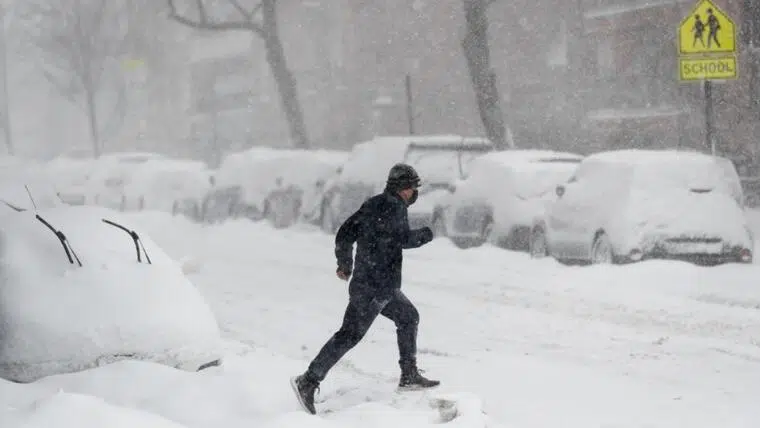
In light of this scenario, transportation officials, including managers of the country’s main airports, have urged travelers to prepare for possible disruptions and delays, as the severe weather system will cross the nation over the weekend.
This phenomenon is expected to gain intensity as it passes through New Mexico and Texas, then head east. Along its path, it is expected to blanket cities like Memphis, Nashville, Philadelphia, Baltimore, Washington D.C., and New York.
According to the NWS, the most extreme wind chill from the snowstorm could plummet below -46 °C (-50 °F) in the northern plains. Additionally, subzero temperatures are anticipated over a much wider area reaching the southeastern United States.
“This intense cold poses a life-threatening risk of hypothermia and can cause frostbite on any exposed skin area,” warned the meteorological agency.
Although it is still premature to precisely determine the volume of snowstorm that will accumulate in urban centers, projections indicate that in certain points it could exceed 30 cm.
On the other hand, in states located further south, there is a risk of freezing rain. This phenomenon could coat trees with layers of ice, causing their weight to topple them and lead to failures in the electric supply.

In addition to power outages, extremely dangerous road conditions, damage to vegetation, and significantly reduced visibility are forecasted.
State of emergency due to the snowstorm
The northern neighbor, Canada, is also experiencing a period of critical temperatures. Meteorologist Geoff Coulson informed CBC News that the eastern provinces and the Atlantic coast could record significant snowfalls.
However, Coulson pointed out that it is still not possible to precisely determine the full magnitude of the effects of this extreme weather.
In the United States, governors of states like South Carolina, North Carolina, and Texas have declared a state of emergency due to the gigantic snowstorm. This measure facilitates the mobilization of response resources and allows the intervention of the National Guard.
Texas Governor Greg Abbott stated in a communiqué last Tuesday that, based on current reports, the state is taking preventive actions to ensure that citizens have what they need before the winter storms affect Texan communities.
It is worth remembering that in 2021, Texas suffered a snowstorm that collapsed its electrical infrastructure, leaving millions of people in the dark and without heating for several days, in addition to compromising the supply of drinking water.
On this occasion, authorities have again warned about the possibility that pipes may freeze and burst due to the low temperatures.
Finally, it is expected that due to the snowstorm, roads will remain impassable for several days, especially in the southern states that do not have enough machinery for ice clearing. This pattern of intense cold is estimated to persist well into the next week.



